Showing posts with label Mentor Text. Show all posts

Help Readers Bloom with Make Way for Ducklings

Spring has sprung, and I am very excited to share a classic Spring story with you and your students. I had forgotten how much I loved this story, until it was gifted to my son, during a recent trip to Boston. 
When we checked into our hotel, the front desk couldn't help but notice my slightly overly excited three year old, who waited patiently bounced off every wall! When they delivered his "very special big boy bed" it came with a welcome bag. He received a water bottle, coloring book, special bedtime snack, and story. To say that it was thoughtful, would be an understatement! 
When tucking my son into bed that night, we read "Make Way for Ducklings" - the most perfect Springtime in Boston story! 
Not only is this a cute leisure bedtime read, but it is also a great read aloud to share with our students. There are many skills we can emphasize with an interactive read aloud. 

Book Summary

Make Way for Ducklings by Robert McCloskey (also the author of Blueberries for Sal) is a Caldecott Award winning story, about the journey of a family of ducks. Starting with Mr. and Mrs. Mallard looking for a place to nest, they fall in love with the Boston Public Gardens. But, after encountering some busy bikers, they eventually settle on the banks of the Charles River. After hatching their ducklings, and teaching them all the ducky ways, Mrs. Mallard does not give up on the Public Gardens. She enlists the help of Michael the policeman, to help her and the ducklings to their final family home. 

Teaching Vocabulary

Teaching vocabulary is so important, and often a skill that is overlooked. Introducing vocabulary can help set the stage to activate prior knowledge, while at the same time, begin to introduce new concepts to our students. Many times I have seen a student struggle to decode a word (that I really thought they should know), not because the phonics of the word was too difficult, but because their vocabulary just wasn't there yet. The vocabulary in this story is rich, not only as an introduction to a study on ducks, but also for words our students will encounter in other texts.
One activity I love to do when introducing new vocabulary, is to read off a list of words before starting the story, and have students predict what the words mean. This gives me a sense of their knowledge, and how much time to spend instructing on these words. I then assign each word to a select few students (the ones I know need a job to stay engaged) and it is their job to listen for their word throughout the story. When they hear their word, they quietly hold up a card to signal it's time to discuss the word. Then, using context clues, we try to uncover the meaning of the remaining words. I also DO NOT limit my students to ONLY the words I selected. Again, sometimes they surprise me with words they are unfamiliar with - and the whole point of going over vocabulary is to build background knowledge for the next time they encounter the word.


Before, During and After Reading

As I mentioned before, this book can make for a nice leisure read, as you transition out of the chaos of recess, however, this story can also be used to practice skills you have covered with your students throughout the year. By using before, during and after reading questions, you can engage your
students by discussing genre, making predictions and inferences and evaluating characters, setting, and important events. The depth our students are able to pull from the story, can truly depend on our scaffolded questioning.
Providing our students with the opportunity to ask questions is another important experience that can create during our interactive read alouds. I try to encourage all types of questions.  My students ask clarifying questions, if they need more of an explanation. But, they can also ask their peers comprehension check questions, which allows them to take on a teacher role. This allows my students to have great input in their learning, and increases their metacognition of the story - a skill (I hope) that will transfer into their independent reading.

Making connections by building knowledge

Normally, we talk about building background knowledge before reading with our students, however after reading is another

opportunity to build on our students' understanding. New knowledge is best developed by the connections students can make. This charming story can make a wonderful transition into a study about ducks, and other oviparous animals.
To further their learning, your students can continue reading about ducks with a paired non-fiction text.  The use of various graphic organizers will support them while continuing to build upon and organize new information. You can check their understanding using differentiated comprehension questions, before finally, students publish their own book "All About Ducks".

This FULL RESOURCE will save you time when planning your read aloud extension activities.


... And there's more

This story has potential to bridge connections with your math curriculum. Mr. and Mrs. Mallard have eight ducklings - that makes a family of 10. Your students could explore ways to make ten, and write word problems about the infamous Boston family. 

Additionally, Mr. and Mrs. Mallard name all of their children with final -ck word family endings. If applicable, a lesson or review of final -ck would be an appropriate phonics connection for this story. Check out some of these "student and teacher approved" final -ck activities!
   
If you have used this book with your students, I would love for you to share how you have made connections and built upon your students' knowledge - you can share in the comments below.

PIN FOR LATER:
Don't forget to check out the other incredible ideas, lessons and strategies shared by my teacher friends, linked below.  HAPPY SPRING!

Check out these other Mentor Text lesson ideas: 


This post was part of a mentor text link up hosted by The Reading Crew. On each blog, a lesson using a book and focusing on a vocabulary, comprehension or writing skill has been featured. The posts and resources from The Reading Crew, never disappoint, and this time was no different. Check out all the posts below

Teaching Onomatopoeia: an exciting POP to writer's workshop


We made it! It is the end of the school year.  High-Fives to you! 
Now like I tell my students, just because testing is over, the weather is warmer, and the end is near, does not mean that we can stop working and learning. This is my favorite time to teach about descriptive language, especially Onomatopoeia. Descriptive Language is a fun skill that can help ease your class into summer vacation. 
I have a really fun book to share with you that can help introduce Onomatopoeia and model how to use it effectively to spice up your students' writing. 


Before reading, I like to share what onomatopoeia is with my students. To do so, I tell a (possibly very true) story about my morning. It goes something like this:  I woke up this morning and got out of bed. SQUEAK! I stepped on one of Reno's dog toys. Mr. Christensen groaned because he was not ready to wake up. SHH! I told him, go back to sleep. I went downstairs to put in a load of laundry and the washer WHOOSHED as I turned it on. Then, I came upstairs to start breakfast for Mr. C and Parker. Parker likes cereal and Mr. C like bacon, eggs and toast. As I turned on the toaster, it TIC, TIC, TIC'ed as I turned the knob, and the bacon SIZZLED in the pan. Behind me, I heard tiny footsteps...then BOO! it was Parker trying to scare me. I scooped him up and gave him a big kiss on the cheek MWAH! Parker helped me feed Reno, and CLICK, CLICK, CLICK went the dog food as Parker spilled it all over the floor. Then, Reno ran into the kitchen and ate it as fast as he could. CRUNCH! While this may not be the most natural story, it certainly helped introduce sound words with my students. It also allowed us to start having a discussion about how and why onomatopoeia can make our writing more interesting. 

Dear Fish by Chris Gall is one story you could use to introduce onomatopoeia to your students. It is a story about a boy, who wrote a message to the fish at the beach, inviting them to come visit someday. The next morning, strange things begin to happen and sea creatures start to visit his house, neighborhood and school. The author naturally uses onomatopoeia to illustrate how the sea animals are invading. The sawfish and hammerhead shark were seen "swooping and whooshing and a hammering and yammering," while the boy's dad was making a tree house. They only left a cloud of sawdust behind them. The illustrations are equally as amazing, as the engaging story and incredible examples of onomatopoeia. My students LOVED this book. The ending is quite a laugh!
 You can find more suggestions HERE, or the Froggy books by Jonathon London are another favorite of mine.

This book is jam packed with examples of onomatopoeia. The first time through, I usually like to just read the book, and let my students listen. I want them to enjoy the story, rather than focus too much on the task. This first day, we talk about the author's style, and how the use of onomatopoeia helps us paint pictures in our minds. The text is much more descriptive because of the use of these sounds words, and it helps draw us in as readers. My students can get there with some prompting, and by talking about their favorite parts with a partner.


The next day, I will re-read the text. While reading, I have asked students to record examples of sound words they hear. I have broken a class up into teams and asked them to record on certain pages. Each person gets a set of post-its and they write the sound words they hear. I know not every student is going to catch them all, so it is great to have them work together. After listening to the story, I have had my students, in their groups, brainstorm situations that would fit the examples they listed. This not only creates a list of words, but also gives students an idea on how to use them in their own writing.

After reading, either on the 2nd day, or even on a 3rd day, compile the list of words on a class anchor chart. Your groups can share out their words and how they might use them. Then together as a class, you could brainstorm more,  or review this FREE onomatopoeia word list.

With the list your class generates, or the provided word list, your students can now help to construct a classroom display that encourages everyone to use more onomatopoeia in their writing. This was my students' favorite part. Students can pick a word, or you can assign them a word, and they illustrate a poster describing the word. For example, for the word 'drip' a student of mine drew a leaky faucet with a drop of water coming out of it. These illustrations have always been so creative and helpful to other students trying to use more onomatopoeia in their writing.  These posters can help inspire a story, or help elaborate on an idea already in progress.


Now that our students understand what onomatopoeia is, what it is used for, and some examples, we need to get them to use it, so they can further develop their style. Here are THREE WAYS that will take your students from "teacher, teacher," to independent when using onomatopoeia.

Teacher Guided: When I have taught this skill, I have lead my groups through some examples of text without onomatopoeia. Together, with my help, my students worked to identify examples of onomatopoeia that could bring the sentences to life. I first modeled how I would think about my options; first considering the actions in the sentence, and thinking about a time that I may have witnessed a similar situation. I explain that in order for our writing to be believable, it is best if we can connect it to a real experience. The freebie above has some sentences you can discuss with your group. The included page is a fill in the blank page, with a word bank, so you could use it morning work, or a bell ringer after your small group lesson.

Collaborative: I think this is one of the most effective ways for our students to explore using onomatopoeia. Writing is a process, and this activity helps students realize that a writer's job is never done. I have my students pick a piece of writing they would like to improve, and with a partner they revisit their writing. They work together to re-read the writing, and make suggestions for opportunities to add onomatopoeia words.  

Independent: Finally, students can write a new piece. Again, writing is a process so it may not come naturally on the first draft. But hopefully they are keeping onomatopoeia in the back of their mind and creating opportunities for it to be added in later. If your students still need some coaching with this skills, you can add story inspiration pages to your writing center that will help to encourage them to write a story based around a specific onomatopoeic example.


I hope you enjoy teaching your students about onomatopoeia as much as I do, and found these suggestions helpful. And now as you ease into the last stretch of the year, you can cross at least one lesson plan off your to do list!

If you have already taught onomatopoeia this year, you can always 
SAVE FOR LATER:


Check out these related posts:
Read Aloud for R-Controlled Vowels
Summer Mentor Text for Inferencing
Spring Mentor Text for Descriptive Language
Spring Interactive Read Aloud


This post was part of a mentor text link up hosted by The Reading Crew. On each blog, a lesson using a book and focusing on a vocabulary, comprehension or writing skill has been featured. The posts and resources from The Reading Crew, never disappoint, and this time was no different. Check out all the posts below

Introducing R-Controlled Vowels with a Mentor Text

A Day At Berns Family Farm is a great text that features R-Conrolled Vowels. Use this text to introduce the new phonics skills with your students and practice decoding strategies.
Hello and WELCOME! Thank you for joining me, and The Reading Crew for another Mentor Text link up. Each blog, will be sharing a mentor text lesson, using a book we've chosen. The lesson will model a vocabulary, comprehension or writing skill. 

A Day at the Berns Family Farm: A Book of Phonics was written by Laura Hudgens, and just published in March. So it is HOT OFF THE
PRESSES! This is a cute story about a family, and all that goes on during the day, on their farm. I think what I loved most about this book is that it was written by an educator, who has worked with K-3rd graders for 16 years. In the note to readers, she writes "This book was created for the student or child that is learning to read and recognize diphthongs." All throughout the book, the vowel teams, r-controlled vowels, and diphthongs are highlighted within the words to help the reader identify them while reading. In full disclosure, I find the highlighted text to be slightly distracting, HOWEVER, my students enjoyed how easy it was to identify the sounds. 


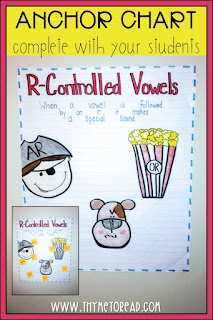
When I introduce a new phonics skill, I try to provide my students with as many concrete "triggers" as I can. I aim for a text, a visual image, and a physical artifact. When teaching R-Controlled Vowels, I now reach for this book! Even though the book highlights various vowel sounds, the title perfectly lends itself to trigger the sounds for R-Controlled Vowels. My students help me come up with images for our phonics skills. This year, my 2nd graders picked a pirate for the /ar/ sound, popcorn for the /or/ sound and a grumpy dog for the er, ir, ur /er/ sounds.  These images are something they can visualize to help them recall the correct sounds. Finally, I try to pick a physical artifact. I found pirate patches at the party store for our /ar/ week, and during our /or/ word study, we popped popcorn. Even more than an image trigger, the multi-sensory experience connected with these fun memories help to develop a strong sound association for my students.

I believe it is important to involve our students in the process of creating reference resources for themselves.  So, we worked together to make this anchor chart that displays the trigger images and words that match the phonics pattern. It is simple, not terribly fancy and something the students can use to help them when reading and writing. However, I have terrible anchor chart envy. I am no artist (I traced the pictures on the anchor chart), and my handwriting skills are not worthy of being on display! So, I created these digital anchor charts. While I illustrated our classroom anchor chart, my students had these personal charts so they could develop their own word list. These charts are stored in their reference folder (a folder that goes back and forth between school and home to provide help when needed).

digital anchor chart to display on board and complete with your studentsWhen teaching R-Controlled Vowels visuals can help trigger the correct sound. Use this visual anchor chart with your students, and brainstorm words for each vowel sound


Modeling, exposure and practice help to yield some of the
best results with our students. One way to provide consistent modeling and exposure for your students, is to instruct them on how to identify vowel sounds in words. Vowel sounds are the key to both encoding (spelling) and decoding. Each time we introduce a new phonics pattern we can give our students practice with these skills. As we know, vowel sounds dictate the syllables in a word. If a student is able to understand this, they will be more successful readers and writers.

After reading A Day at the Berns Family Farm, you can lead your students through this decoding practice, featuring words from the book.  Then, with this list of newly acquired words, your students could write their own "Bossy R" story.

Not sure how to explicitly teach your students how to decode an unknown multi-syllabic word? Following this step by step procedure might help them, when sounding out the whole word is just too overwhelming:
You can also check out THIS post/video on how to decode ANY multi-syllable word!

https://www.pinterest.com/pin/183873597268626635/If you are looking for more practice for your students, this FREE R-Controlled Interactive Mini Book focuses on ar and or phonics skills.  The notebook is made of half page foldables that introduce twice the content, in half the space. And because time is precious, there is limited cutting and pasting! Your students will have picture clues (picked by my students) to help recall the correct sound each vowel sound makes. Additionally, the list of words I generated with my students, has been included in a completed "anchor chart" reference page. Your students can practice encoding words with Bossy R sounds, as well as decode multi-syllablic words that feature R-Controlled syllables. Lastly, your students can cut, sort and glue picture cards identifying the vowel sound in each word. This resource is full of explicit practice perfect to include in your teacher guided whole class or small reading groups, while the R-Controlled concepts are still "new learning".
If you are looking for the ar, or, er, ir, ur notebook, you can get the FULL version for just $1.00

https://www.pinterest.com/pin/183873597268623919/As your students become more comfortable with R-Controlled vowels, it is time to release some of the control back to the students. You can first do that through the use of collaborative centers - where your students work together - two minds are better than one. Together, your students can:
  • assemble puzzles featuring R-Controlled vowels. 
  • identify which word is spelled correctly, using a "what looks right" strategy
  • write more stories using "Bossy R" words
  • complete a word search full of R-Controlled words
And finally, because our students deserve it... some FUN! After a few weeks, I like to incorporate a little review, by playing a game with spiraled phonics skills. My students love a good BINGO-like game that encourages quick and accurate reading of previous taught phonics skills. Now that our students have had plenty of practice, it is OK to the put the pressure on, and keep the pace of the game up. Hopefully, a few weeks out, our students are recognizing the vowel patterns more quickly and decoding the words accurately.
 Thank you for stopping by and reading about how you can introduce new phonics skills using a mentor text. Our students love being read to, and by sharing literature that reinforces the skills we are teaching, our students will acquire the new skills with ease. I am always interested in find new ways to introduce phonics skills to my struggling readers, so if you have a book, or multi-sensory concrete artifact you would like to share, please leave it in the comments!

If you are looking for more mentor text lessons, you can check out other SPRING and SUMMER texts here. 

PIN THIS POST FOR LATER: 
https://www.pinterest.com/pin/183873597268742387/
 
This post was part of a mentor text link up hosted by The Reading Crew. On each blog, a lesson using a book and focusing on a vocabulary, comprehension or writing skill has been featured. The posts and resources from The Reading Crew, never disappoint, and this time was no different. Check out all the posts below
An InLinkz Link-up

Mentor Text Lesson to Warm Up Your Winter

Brrrr! Winter is in full swing here in the Northeast. I know I am doing everything I can to stay warm. If you are experiencing a little chill too, I hope me and my friends, from The Reading Crew, can bring you a little warmth and inspiration through our Winter Mentor Text link up. 
On each blog, we will be sharing a winter mentor text lesson, using a book we've chosen.  The lesson will model a vocabulary, comprehension or writing skill. The resources shared may be forever freebies, or may only be free for a limited time. Please take note of this as you visit each
blog.  So grab yourself a nice warm beverage, and settle in while you learn about resources you can bring back to your classroom in the new year.
This fall my family moved "back home." With moving, came a new house, new daycare for my son and a new job for my husband. For me, after being a reading specialist for the last four years, I'm not sure if I could handle one more big life change. So, I consider myself very lucky to have kept the same position in my new district and school.  I am now a proud POLAR BEAR (my new elementary school's mascot)! Well, when asked to pick a book for this link up, I knew just the one! The Polar Bear, written and illustrated by Jenni Desmond.

The Polar Bear is an informational picture book about the polar bear's habitat, body, diet, and life. The story is told through the eyes of a young girl who is reading a book about polar bears, and her character is placed in many of the illustrations. The factual text is paired with fantasy like illustrations that won this book the New York Times Best Illustrated Children's Book of 2016. Desmond does a wonderful job of presenting factually accurate information about polar bears in an easy to understand way. For example, Did you know the bumps on a polar bear's paw are similar to the bumps on a basketball? Desmond seems to be creating a "series" of nonfiction picture books, by writing about "vulnerable and threatened species." Her first book (for Enchanted Lion publishing) addressed blue whales, and her next book is set to uncover the life elephants.  

As I said before, I am now a proud Polar Bear! When I introduced this text to my students, I prefaced them with my wish to get to know our school mascot. I don't think it is enough to just know what our mascot is, we need to know why we are Polar Bears, what characteristics do we have in common, and what can we learn about the animal to make us stronger Polar Bears. Well that did it for my kiddos, they were all in.  Unless your school mascot is also the Polar Bear, you will need to think of a bigger "buy in." But, I must say that polar bears are really interesting creatures that deserve to be more understood. With the winter season upon us, there is no better time to study and explore the Arctic. You could use this book, and the resources available as a collaborative research project, that sets the stage for the students to begin their own Artic animal research projects. Before reading, you will want to provide the students with the note catcher (provided in this resource), so they can be actively listening and recording facts about polar bears. If working in small groups you may only want to tackle a few key topics at a time. Or, if you using this text with the whole class, you may wish to break the class up into groups so they only have to focus on a few topics, and later have the groups share out their responses. 


https://www.teacherspayteachers.com/Product/Paraphrasing-for-Polar-Bear-Research-2937754
 While reading this text aloud, stop to discuss vocabulary (evolved, repellent, solitary, etc.) and use the illustrations to construct more meaning for your students. Use some of this time to show your students how they can listen for key words in the text, and how those words can help them to predict when an answer might be coming. Also, use this time to show your students how you want them to use the provided notes catcher.  When using graphic organizers, I always take into account the ability of my students. My first graders are still working on writing a complete sentence, so to tell them they don't have to on a graphic organizer is very confusing, and sends mixed messages. My firsties always write in complete sentences. Although my second graders (and up), have a better grasp of being able to go back and forth based on the task. I allow them to just write key words and phrases. This also allows me to then help them answer questions in their own words and paraphrase the text. In the full resource, is a graphic organizer with suggested topics (and it is fully editable) to help guide your students while listening to the text.

An alternative to reading the whole text aloud to upper grade level students, would be to split the class up into groups and copy pages from the text. The students could read the section provided to them and pull out the relevant information needed to answer the questions. You could also provide them with supplemental texts on polar bears so their information comes from various sources.

https://www.teacherspayteachers.com/Product/Paraphrasing-Practice-FREEBIE-2937724
After your students have pulled key details from the text to address all of the topics, you will need to instruct them how to paraphrase. Paraphrasing can help your students bring in prior knowledge, show their deep understanding of content and also better remember what they have read. The sooner your kiddos can begin practicing paraphrasing, the better. My younger students (grades 1-3),  always paraphrase, however for my older students (grades 4-5), I teach them cite, then paraphrase. To teach paraphrasing, I have my students re-read the section they are trying to summarize, re-read their notes, close the book, turn over their paper and answer my question using the 4 R's of Paraphrasing.  In this forever FREEBIE, is an anchor chart and quotes from the text for your students to practice paraphrasing (editable options of both are included). Teaching students to paraphrase takes a lot of modeling (with think alouds), practice and time. When my students have had the most success, it is because they have been able to discuss their ideas with a partner, before committing them to paper. 

After your students have successfully answered the key questions, they can publish their polar bear research project. Included in the full resources is a student publishing book. The pages included address the same topics from the note catcher (and there is an editable page too!) My students of course enjoyed answering my final question of 'Why are you proud to be a Polar Bear?' They used the information they learned from the text, and we developed a list of qualities of a polar bear. They thought about how they have or could embody these qualities to be the very best Polar Bear they could be. As an extra bonus, I have included this question on a page of the published book.
Even if your school isn't the "Polar Bears," your classroom could adopt this amazing animal as a classroom mascot. Or, your class can use the included animal research template to provide information about various animals that could become your class mascot. Tie in some persuasive writing, a lesson on democracy, and you have yourself a class mascot election! 
 To Summarize: Paraphrasing is an important skill for your students to practice. By using the 4 R's of paraphrasing (Remain, Replace, Rearrange and Recheck), and explicit modeling/guided practice, your students will gain ownership of new content. The Polar Bear by Jenni Desmond, is a wonderful text to practice paraphrasing and then follow up with some simple animal research. Your students will not be able to resist sharing all they learned in this adorable All About Polar Bears book.


PIN THIS POST FOR LATER!
https://www.pinterest.com/pin/183873597267029994/

PIN THIS RESOURCE FOR LATER! 
https://www.pinterest.com/pin/183873597267029998/

Check out these related posts:
Fall Mentor Text for Theme
Spring Interactive Read Aloud
Spring Mentor Text for Descriptive Language

This post was part of a mentor text link up hosted by The Reading Crew. On each blog, a Winter mentor text lesson using a book and focusing on a vocabulary, comprehension or writing skill has been featured. The posts and resources from The Reading Crew, never disappoint, and this time was no different. Check out all the posts below


Powered by Blogger.
Back to Top