Showing posts with label Motivation. Show all posts

Reinvent Your Prize Box Now - Reading is the Prize

classroom prize box reading is the prize reward reading with reading thyme to read

I recently shared a picture on my Instagram about my prize box. I received quite a few questions about it, so I thought I would share more here! 

First let me say, that I have not always been a prize box teacher. I would start off strong with rewarding "something" whether is was good effort, reading growth, or a 'wow' moment, but I never had the follow through. I certainly was not promoting any good behaviors or growth in my students with my lack of consistency. Once I realized this was the kind of teacher I was, I moved away from the prize box. 
And that's OK! You have to do what is right for you! Your students are not going to think less of you because you do not have a prize box. You can think of others ways to praise good behavior,  strengthen positive attitudes, develop growth mindset or celebrate goals, and your students will appreciate them just the same. 

So, why did I jump back on the prize box bandwagon?

It's pretty simple. I joined a team that was PRO prize box! Maybe not the best reason, but it's the truth. I started teaching in a reading intervention room with three other teachers, and they were all about the prize box. *Sigh* 

How could I, the new girl, be the only one who didn't use a prize box? For example, we can have 16-20 second graders in our room at one time, and how can my 5 be the only ones NOT getting to go to the prize box? I had to find a way to make rewards work. 

So, I thought about what was really important to me, and my students. If I was invested, they would be invested. Then, I realized that my students LOVED when I would print a book off Reading A-Z, we would read it together, and they would get to keep it forever. It was not the sticker, star or stamp that I put on the forever book, it was the actual BOOK.  *Ah-ha*

And so, the Prize Box was born (again, but better)! My students were motivated because they loved getting books that they could take home and keep forever. I was motivated because, what teacher doesn't like giving out books and seeing their students read them. This was a prize that I could actually commit to! 

How does the Prize Book Box work?

classroom prize box reading is the prize reward reading with reading thyme to readMy students K-2 have "homework". Each week, I put a sight word review sheet and a book to read (usually it is a re-read of a book we read in group the week before). My first and second graders also have a reading response question they are responsible for.  It isn't a lot of homework, but it is purposeful and encourages my struggling readers to read at home. If they are making progress on their homework each night, they earn a point on Class Dojo. When they have 25 points (or 5 weeks of doing homework), they earn a book. A real book that they can keep FOREVER
My 3-5 graders earn books a little differently. They do not have assigned reading homework from me, but they do have assigned reading from their classroom teacher. I piggy back on this, and offer them a some reading challenges/reading menu to encourage them to read different books. As they complete these challenges, they earn a book from the prize box. 
**You can get the cute Reading is the Prize poster from Hello Literacy's TpT Store, it is a FREEBIE

Where do the books come from?

All over! 
Primarily, I order the books from the Scholastic book flyers. I only order the $1.00 books. There is a wide range and they are appropriate for all of my students. I try to replenish the number of books that were taken from the prize box, plus one or two to keep a variety of choices available. But, I do what I can afford. It does come out of my own pocket, and that is my own choice. I'm sure if I asked to have money put away for the prize box, it wouldn't be a problem because I do not spend my budget money on stickers or other trinkets. 

I started my prize box collection at a garage sale. You can easily find gently used books at garage sales for CHEAP! If you are lucky, and you happen to mention you are a teacher, sometimes they are nice enough to just give you a bag to fill up. It has happened. 

classroom prize box reading is the prize reward reading with reading thyme to read

Similarly, check consignment sales. My area has a few each year at an indoor sports facility. It is mostly clothes, and baby gear, but they have a nice selection of gently used books. You do not get the "teacher discount" here, but you can still get a big bang for your buck. I just found out the next sale is opening early for TEACHERS! If you find a consignment sale, it can't hurt to ask if you can come in early just to shop the books. 

And, don't forget to check your local library. They may occasionally have book sales too. This is great because the money you spend on books from the library sale will go back to the library so they can buy new books to fill their shelves with. And that is a win-win-win for everyone involved! 

Do you have more ideas on where to get books for cheap? Please share them below in the comments so we can all check them out!

Do your students think they are missing out?

I was asked if my students feel like they are missing out because they do not get a toy or a little notepad or a fancy pencil. And my answer was ABSOLUTELY NOT! My students brag about their new books, and the other students wide eye stare with excitement. Is there jealousy? I don't think so. My students wide eye stare at the toy cars and fancy pencils too. But no one complains about the prizes they have been given. I know my students appreciate the hand written note of praise that accompanies their book (and the parents do too). And all I can hope is that the excitement of the prize book lasts a little longer than the excitement of the toy car. 

I do want to add that I put my prize box on a bit of a pedestal. Much like you wouldn't let your students play with the toys in your prize box, my students cannot free read the books in my prize box. They are the most special books in the room! It helps to keep the appreciation of the prize box alive. If they were able to read them anytime, then what would they be working toward? 

How do I feel about the prize box now?

I'm loving my prize box! It took some time to figure out what worked for me, but I am excited when I can gift a new book to one of my students. I have finally matched the behaviors and habits I am trying to develop in my students, with the excitement of the reward. I am REWARDING READING, WITH READING! 
PIN FOR LATER: 
classroom prize box reading is the prize reward reading with reading thyme to read

IN SUMMARY:
  • If you are going to have a prize box, make it one you can commit to
  • Start small. You can praise the small moments, and reward the bigger milestones.
  • Check garage, consignment, and library sales and/or Scholastic Dollar Books to build your "inventory"
  • Reward the behavior with something that reflects the behavior. Reward reading with reading, because READING IS THE PRIZE! 

So do you use a prize box in your classroom? How do you make it work for you?


How You Can Motivate 21st Century Readers with Technology

Find out how using technology in the classroom to can help promote 21st Century Skills with your readers.

"You are not old until you feel old," is something I would say to my grandparents when I was a little girl. And gosh darn it, I certainly do not feel old, until my students start showing me up with their awareness and fluency of technology! The world our students are growing up in, is NOT the world we grew up in, no matter how old you are. But, it's our responsibility to equip our students with the skills that will be crucial to their success later in life. No pressure! ๐Ÿ˜…๐Ÿ˜‰
Before I share my four tips with you, I think it is important to share a little about "What are 21st Century Skills?" I feel like the phrase '21st Century Skills' is thrown around a lot, and has gotten a 'bad rep' as just a buzz word. But, I took some time in my third year of teaching (once I finally felt like I could get my head above water) to really try to better understand what everyone was talking about when they said "21st Century Skills". The website linked above was a big help, and I encourage you to check it out. In quick summary, they are the skills that will allow our students to be technologically savvy, strong communicators and superior critical thinkers.

Flip the format

Like I said, our students are growing up (and will work) in a different world than ours. They have a wealth of technology literally at their finger tips, and therefore unmatched access to information. We can help support them by introducing a variety of text formats. Playaways, Podcasts, eBooks, and even self-created audiobooks can help our students become more aware of the ever growing and changing technological world of theirs. 

Sharing our love of literacy is an imperative first step, but we have to continue exposing our students to the different technology tools that can also support them in their reading journey. Playaways, audiobooks, and text to speech tools, can help bring equity to our classrooms by allowing struggling readers to access information that would have caused them much frustration. Podcasts are a great way to expose our students to different viewpoints, and can help to develop students' critical thinking. One of my favorite lessons ever, was when I pushed into a fourth grade classroom. The students were listening to a podcast about a colonial trade (presented by tradesmen of Colonial Williamsburg), and taking notes for research. My struggling readers were never so engaged and actively participating, because all of a sudden, they were on an equal playing field.

Promote Creativity and Innovation

Following my students' extensive research of their colonial trade, it was time for them to 'show what they know'. They were given the chance to create a cartoon, with self-recorded voice overs. They included facts about their trade, and shared opinions about why their trade was important to colonial villages.

Here is a list of websites and apps that your students could use to make videos to 'show what they know'. My students used Toontastic, which is sadly no longer available. However, Animoto is another student friendly site that I have used in the past, which can accomplish the same outcome of creating animation.

You can further promote creativity and innovation by:

      Find out how using technology in the classroom to can help promote 21st Century Skills with your readers.
    1. giving up control to the students. By allowing students to spread their wings and take charge in their learning they will learn to develop their curiosity. 
    2. encouraging discussions. Students can learn best from each other, and the conversations will help them to begin developing the life long skills needed to work on a professional team. You can support your students in this process by providing sentence frames for accountable talk.
    3. providing time for reflection. When students are given time to critically reflect on the work they have done, they are able to consider things they would have done differently and open up the doors to more growth. 
    4. celebrating wins. Students deserve to know their work and effort is appreciated and recognized. Taking time to celebrate wins, even the small ones, will give your students the motivation and encouragement to keep taking creative risks. 

Collaboration is Key

A little side note: my husband works at a high level technological research university, and he often comments that his students struggle to work in teams. It has been his job, to teach leadership courses that would help these future engineers to develop stronger collaborative skills, and support them in working with a team. 

So, how can we help our students develop the skills they will need later in life? Teach them how to work collaboratively with their peers! We can incorporate daily opportunities for our students to work together. Even our youngest kiddos, can start by working together to complete a puzzle. We can progress them further by asking them to put the letters of the alphabet in order. We can ask our 2nd graders to become 'experts' on a topic, and then work with a partner to share facts that can later be used to complete an activity.  Our 4th/5th graders could complete a similar activity but on a grander scale with the whole class (World Cafe protocol). By requiring our students to rely on another, they can rise to the occasion to be a teacher, and a listener.
You can check out more collaborative protocols to use in your classroom here.

Taste of the "Real World"

I may be in the minority as I confess, I still hand write my shopping lists each week. There is just something about having a growing list on the fridge that everyone can add to (or forget to add to) each week as we run out of things. It's my system, and I like it. However, other than maybe a thank you note, when was the last time you hand wrote something of substantial meaning?

So, let's give our students more of what they will experience in the "real world" - TECHNOLOGY to help them complete a task. Most of our students are pretty savvy with playing games, drawing pictures, even my three year old can capture a pretty good picture. But these activities are not helping them to communicate with others to share their message or point of view.

You can incorporate technology and encourage teamwork with the use of a collaborative "whiteboard" like Padlet or Boardthing. With my littles, I have them work together to see how many phonics based words they can find during their independent reading. For my upper grade students, I propose a question, they can respond on the whiteboard, and their peers can read their response, before leaving feedback.

Is it just me, or does the world not function without Google Apps? I remember when my school finally converted to Google Accounts, I thought the skies opened up and rained Skittles (like only red ones too)! We can begin introducing our students to GAFE (Google Apps for Education) right away. My littles use Google Apps to complete word work activities (GOODBYE LETTER MAGNETS), my older students and I collaborate on their writing, and all of my students use graphic organizers on their devices to illustrate what they learned from a text.
Find out how using technology in the classroom to can help promote 21st Century Skills with your readers.
By introducing these different forms of technology, we can make great steps to expose our students to the types of experiences they will have in the future. 

SAVE THIS POST FOR LATER:
Find out how using technology in the classroom to can help promote 21st Century Skills with your readers.

I am by no means a 21st Century classroom expert, but I am trying and learning as I go. Each year, I challenge myself to get better at promoting innovation, creativity and collaboration with my students. Please feel free to share ways you have encouraged 21st Century skills in your classroom. I would love you to share your successes with us, so we can all be motivated to try something new or different this year!


Three Things to Help You Become a Better Teacher


Hopefully you are finding yourself rested and relaxed after taking a well deserved break from the classroom. In the midst of all our "resting and relaxing," I know we were also pinning, instagramming and dollar spotting our way into this school year.  There is just no easy way to turn off the teacher brain. But...'Tis the season to really start thinking about your next group of students.  So, I am here to share with you a few more ways, that aren't so #InstagramMadeMeDoIt worthy, that you can do to make this the best school year ever. 


Build Connections

For two years, I was the ONLY reading teacher in my district. My island was very lonely. It took me almost a year (a very sad year, where I wanted to leave the profession all together) to realize that I needed help. I needed to find like minded people who understood my struggles, and shared the same passion for teaching, and that could lift me up when I needed it. Social media was not enough, clicking a like button or saving my favorite ideas were motivating, but not inspiring. 

So, my first bit of advice, is to FIND YOUR PEOPLE! Which, good news, you have already started doing. You have some how stumbled upon my blog - if this is your first time here, I hope stay to look around and get to know me a little bit. If this is not your first time here, welcome back! I hope you have found the tips and strategies I share to be helpful. Please, whether you are a new friend, or a long time friend, reach out and let me know you are here. I want to connect with you. If there is another blogger you like, reach out and email them too. Our community is large, but it can be very tight. You are never alone, and other teachers are your best resources. 

A few years ago, I attended a conference that briefly spoke about "capital" in education. Yes, like the actual wealth or value of resources available in education. It is no surprise that the schools that invested in their "professional capital" - their teachers, their professional development, and their well being showed positive achieving outcomes. This almost seems like a no brainer, but this is what motivated me even more to truly make friendships with some of the teachers I admired on social media.  If you are interested in reading more about "professional capital" you can check out this link HERE.


Set Goals

Rome really was not built in a day, week or year... and your classroom won't be either. My second bit of advice is to take things SLOW. I know we all have a lot of ground to cover, so we strive for immediate perfection. However, I don't think that ultimately benefits our students. So, rather than spreading yourself thin, dig deeper, and do it REALLY WELL. Take time to get to know your standards, curriculum, and students. 

It is OK, to be OK while you are building your toolbox. Consider setting a goal for yourself each month, and work to become an "expert" in that area. The month before school, you may choose to research your plans for a classroom management system. Next month, you could set a goal to "nail down" your phonics instruction. Then following month, set a goal to improve your math instruction. You can do this by seeking out the guidance of colleagues, requesting to attend professional development sessions (or finding them free online), reading professional texts, etc. I have followed this "tip" every year, and it allows me to improve on one thing, and not overwhelm myself with "all the things."

Please don't read "take is slow" as permission to "take it easy". The purpose of setting goals, is to identify the areas in your classroom that will promote the most success for students. It may be based on areas of academic need for your students - for instance maybe your students this year need help in an area where your past students really succeeded, so it is time to brush up on that area. Or maybe it is an area in need of improvement based on an evaluation from last year. No matter what it is, set your goals, with the clear purpose of improving your professional practice and the success of your students. Then execute, you and your students deserve only the best! 


Don't Forget to Take a Break

As the good 'ole saying goes "Happy Wife = Happy Life" and we all know the truth this statement carries. But, we are talking about ourselves as teachers, not as parents, or spouses, or friends.... but maybe we should be? Being a teacher is only part of our identity. We have to honor the other parts of who we are, so we can be the best teachers possible. Don't forget to take time for your family, your friends and most importantly yourself. Do some soul searching to find out what really recharges your batteries. Is it running, crafting, reading, working in a garden, volunteering with animals? Whatever it is, do more of it. Schedule time on your weekends not just for lesson planning, but for you. 

I struggle with this the most. As teachers, we give so much of ourselves and there is often little time for us to be "selfish" so we can do something we love - even if it is just taking a nap (no judgements)! But, when I do take a break. I always head back to school on Monday feeling like a better version of myself. I take more risks that week, and my students have more fun learning. It is really a win, win. 


I hope you are ready to tackle this year head on, and make it the best year ever! In the comments, please share other tips you have, or ways you like to "take a break"
We are all in this together, and I look forward to hearing from you.

Check out these related posts: 

PIN FOR LATER:


Looking Back at Class Dojo: One Successful Year Later


When working with small groups, I rarely have behavior issues. So you may be asking yourself, "Why do you use a behavior management system, 
and how effective could it really be?"
Well, let me start off by saying that I have long struggled with how to motivate my students to develop positive reading behaviors. Behaviors like persistence, participation, and stamina, are just not yet a part of my students' independent reading toolbox.  However, I feel these behaviors help bring about the most success. 
So, I was very thankful I found Class Dojo. 


Class Dojo was very easy to start using! Once you create your account, you can start to add 'classes', 'students' and 'groups'. They even provide you with a demo class so you can practice with a "class" that won't be effected by the adding/subtracting of points, or adjusting the points criteria.  I suggest you play around the demo class for a little bit before creating your real class.

Once you are ready to make your own class(es), just click on the plus sign (similar to creating a new Pinterest board) and follow the prompts. Here is my desktop dashboard with all of the grade levels I work with.


A classroom teacher's dashboard would probably only have one class, but once you click into that class, you could have different groups. I have different groups based on my push-in and pull-out groups. This helps so I can award points to a whole group, rather than just individual students. Here is a picture of my 3rd grade groups. It's really nothing spectacular, but it is a great way to award points when the whole group is working collaboratively and actively working toward group goals.

So now that you have your students and groups all set up, you can also adjust your criteria for awarding and deducting points. You can edit this criteria to match whatever your classroom needs are.  At first I chose to only reward the positive behaviors, my students could not loose points. I really wanted to encourage my students to start participating and asking questions when they needed clarification. I also wanted to celebrate when my Tier 3 students met their weekly goals. I didn't feel these were points that should be taken away from them, once they were earned! I can also adjust the points value, so if I really wanted to encourage "Strong Reading Stamina", I might bump that up to 3 points for a little bit.

Class Dojo has a really fun chime when positive points are awarded, and a really bumming buzzer when points are deducted. I found these to be slightly distracting.  If I didn't immediately award points, I would forget to give them out, and then also forget to directly acknowledge the student modeling the positive behaviors.  If I gave the points, with the sound on, students wanted to know who it was for and why - my lessons came to a bit of halt so we could talk about the behaviors.  Instead, I chose to turn off the volume on my iPad, and when we had a transition, I commented on the students who did a great job and had earned additional points. Problem solved!

But wait...there is more to Class Dojo. It is not just a behavior management tool...yes, it does get even better!

Class Dojo has a parent communication tool.  It actually looks quite a bit like a Facebook Wall, and a text messaging app (so it is very user friendly). Families can provide an email or a phone number in order to access their child's account. They can see the points that were awarded (or deducted) that day/week. They have the opportunity to message you (the teacher) privately, that is the text message or email similar portion. I have heard there is a way to set "office hours" so families know when to expect a response, or quiet hours - however I have not found how to set that. Please share in the comments if you have figured out that feature!

Then, you can also have a "Class Story" that mimics a Facebook Wall.  You can post updates,
reminders, pictures, and more. Families can comment publicly and interact with the other families in your classroom.  What a great way to build classroom community, beyond the walls of your classroom. If you have been hesitant about starting a class Instagram or Twitter because of the public views, this may be a good place to start, because the only people that can see the account are those that have given you their phone number/email, and YOU have given access by invite.

But wait...there is more to Class Dojo.  It is not just a behavior management and communication tool...yes, it does get even better!

Class Dojo has some pretty fabulous features that allows it to be a great tool for progress monitoring.

For instance if you have a student that is struggling with behaviors, you
can monitor how those behaviors are improving over time - you have the option to view various time frames (this week, previous week, this month, previous month). And, with the awesome graph, you can visually see how these behaviors are improving as well.

In my classroom, I had a student that was struggling to work independently.  I knew that I would be adding and DEDUCTING points for this specific skills, so I created a SECOND avatar for this kiddo. With his classroom teacher, we set a reasonable goal of "Kiddo will be able to work independently for three minutes." After three minutes, I would check in with him to see the work he completed, if he was on-task and the work was satisfactory, he earned a point for meeting his goal. If he was distracted, or did not complete the expected work, points were deducted. He could visually see his progress, percentages were readily available for us to review as well. As a team, we were able to use this data to adjust his goal.  Not only did we up the time on task from 3 minutes, to 15 minutes throughout the year, but we also increased his percentage of completion from on task 70% of the time, to 90% of the time. This data tracking would have been so much more difficult without Class Dojo. Just the click of a button allowed for us to have this amazing information available for the student, team and family!

The good news is, Class Dojo is always adding more fabulous features. Just last week, they added student portfolios. I haven't had a ton of time to explore this new feature, but from what I have seen, it looks like the progress monitoring options are only getting better! 

My students had a lot of fun with Class Dojo this school year, and I'll be honest, I did too. During the last month of school, I had a lot of families ask about what they can do over the summer to help their children practice reading.  I heard so much about the struggle with getting the kids motivated to read!

I think we have all experienced the resistance students have to read.  Even if we have worked through that road block in the classroom, when we send these kiddos off on summer vacation, they lack the extensive classroom libraries and guidance we provide them when selecting quality reading material. They miss our encouragement and "hip-hip-hoorays!"

I have sent home BINGO boards, summer reading packets...you name it, I've probably sent it home.  But sadly, it either doesn't come back, or it comes back incomplete and poorly done. Ugh! So this summer I decided I was going to start a "Book Club" on Class Dojo. I sent home a letter explaining the plan, and asked families to sign up/volunteer their participation. I advertised this book club as a fun way to keep reading. The pressure would be low, but engagement would be high. I explained, I know summers are busy, so it wouldn't be a huge time commitment.  With about ten students in my book club, I was pretty pleased with the response. Not shabby for my first year.

So what have I been up to with this book club so far this summer?
Each Monday (at 11:00 A.M.) an alarm goes off on my phone to remind me to send out my weekly challenge.
On the "Class Story" page, I type up a quick check in. You know students love to know about more about us, so I told them we went to the zoo and the lake. I told them Mr. Christensen celebrated his birthday and because he doesn't like cake, I had to make a giant cookie! I usually give a shout out to one of my readers, and encourage everyone to keep going because I LOVE finding out what they are reading. Then I give them their actual challenge. It is different each week, and flexible.

Here are my weekly challenges so far:
Week 1: Read outside (it was the first week of summer vacation and the weather was PERFECT!)
Week 2: 4th of July so I asked them to read a book about summer, or a book about our country
Week 3: My family went to the zoo, so I asked my kiddos to read a book about their favorite animal
Week 4: It was forecasted to be pretty rainy, so I asked them to build a tent and read in it.
BONUS: Flashlight Friday - we do this in school sometimes and they love it. We turn off the lights and read with flashlights.

To check in, my students/parents send me book titles, reviews, summaries, highlights, hand-drawn pictures, or photos of them reading. Whatever they want to show/tell me about their reading. With all of this, I can be pretty confident that my students read at least ONE book that week.

With this summer reading challenge, I have coordinated with a local ice cream shoppe - any student that completes 70% of my challenges,  will get a coupon for a free ice cream sundae.

However, throughout the school year, I have a different reward system.  Just as the point criteria is flexible, I wanted my reward system to be flexible too.

I really didn't want my students to model these essential reading behaviors just because they were going to get rewarded. So I developed a system that could be adjusted throughout the year. On a daily basis, I awarded my students Dojo Points.  In the beginning of the year, it was like every minute - we really needed to correct some lax summer habits! As the year progressed, my kiddos needed to work for it a bit more.

In conjunction with the Dojo Points, I allowed my students to cash in
points, for Dojo Dollars. At first three points = $1.00, then it was five points = $1.00

https://www.pinterest.com/pin/183873597265939488/Then finally, my students could use their Dojo Dollars to buy
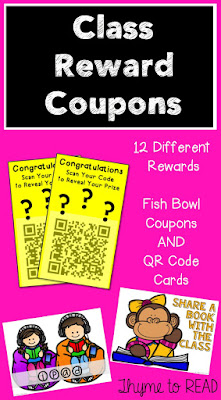
coupon reward cards.  Again, throughout the year I 'upped the ante' by increasing the cost of the rewards.

My students were completely fine with me upping the stakes throughout the year, they knew to expect the unexpected with me! I would reward them "gimme weeks" when I would make the reward cards $1.00 and give points away like crazy (weeks following holidays and vacations so I could re-establish expectations).

https://www.teacherspayteachers.com/Product/Class-Reward-Coupons-with-QR-Code-Option-2683451If you have a special coupon request that you would like for your classroom, please leave your request in the comments below, or email me at, megan.thymetoread@gmail.com
You can grab my Class Reward Coupons with QR cards, HERE

If you are looking for more information about Class Dojo, here are a few other blog posts you might enjoy! They are filled with more ideas and systems that might work in your classroom.

Going Strong in 2nd Grade: Class Dojo (multiple posts)
Teaching Trio: Using Class Dojo Effectively
Edutopia: Classroom Behavior? There's an app for that
Sixth Grade Tales: A management system that works!

If you use Class Dojo, I welcome you to share your experience in the comments below. If you have a blog post you would like to share, please feel free to drop a link in the comments as well.

Pin for later:
https://www.pinterest.com/pin/183873597265939548/

Check out these other related posts:
Reward Reading with Reading Prizes
Quick Tips to Become a Better Teacher
What is in Your Teacher Survival Kit?


How to Avoid the Summer Slide


If we can all be honest with each other for a moment, at this time of year, we are fully looking forward to summer. We are heading full steam ahead toward vacation, and not taking much of minute to look back. But, I'm going to ask you to slow down for just a second.

Since the beginning of school, your students have heard your voice (probably in their sleep) telling them to read, practice, read, review, read... you know what I mean. In a few short weeks our voices will start fade, and the excitement of summer will take over. All of the work you and your students have done this year will be replaced with ice cream brain freezes. Then when the students return in the fall, you wonder where all the hours spent practicing and progressing last year went. Then you remember...

THE DREADED SUMMER SLIDE! It gets them every time.  

I hope to share you with some information about what the research says about the summer slide, ways to make books accessible to your students, games you can use during summer school for additional reinforcement of skills, and a few freebies that can help you, help your students, fight the summer slide.
Dr. Richard Allington is an Education Professor at the University of Tennessee, whose research has included reading/learning disabilities and effective instruction, especially in classroom settings. He has done amazing research that looks at the "summer slide," and ways you can set your students up for summer success.

To summarize some of his research:
      • Low income students lose 2-3 months of reading development over the summer. This accumulates to 18 months lost by the end of 6th grade.
      • Middle-High income students typically gain a month of reading development over the summer. 
      • When books are GIFTED, the effects on reading development for low income students is greater, than when books are LOANED
      • Over time, low income students read more than 1/2 year better than those who do not receive books for voluntary summer reading.  

After looking at and reading an extensive amount of articles and research about the summer slide, I started to notice a trend. Students first need ACCESS to books. I will dig more into this point in just a second. Students also need to be reading texts that INTEREST them, and are self-selected. This means assigning summer reading projects may not be in the best interest of your students. The texts the students have access to should be LEVELED, so they can practice appropriate skills and strategies throughout the summer months. Lastly, if students have access to a summer reading program, it is best structured like a "CAMP" - for example encourage learning through exploring and having a less structured environment. These "camps" have the greatest impact for students in grades K-2 and 9-12.

Now that we know what we should do for our students, how do we make that happen? We have to get books in our students' hands and I have complied a list of ways that you can do just that. I recommend working with a team. These summer access solutions cannot be done alone. You will need support of administration (financial and general awareness) and additional man power (parent volunteers can help).

Dr. Allington suggests:
- Allowing students to check out a significant number of books from the school library at the end of the school year. Starting small (5 books) in May or June, then when books are regularly returned, increase the number of books going home. This plan would require extended library hours during the summer so children can come back to school after families get out of work.
- He also recommends having a book fair during the last few weeks of school. This allows the opportunity for students to increase their home library right when they need it most.
 - Another idea of his, is to start an "honor library". An "honor library" would be a selection of books which the students can take, and on their honor return, so they can get another book. This is different because there is NO library loan - the books are left accessible outside of the school entrance.


Start a book bus.  The Oklahoma City Thunder NBA basketball team outfitted a school bus to be a mobile library.  Now while is may not be realistic on a teacher salary, or even for your school to construct, you can still keep this concept alive.  If you strip this bus of all the fancy, you have a MOBILE LIBRARY.  If you have car, truck or van,
you can meet your students to make books accessible. Set a day and time each week that you can meet them at the local park or a highly populated neighborhood. This is when some additional man power would be great - rotate with your colleagues or volunteer families. But if you are consistent and they will come.

If your students are having a hard time getting to you at the park or another summer hot spot, keep thinking. They are somewhere, and that is where the books
need to be.  When I realized that my school was a summer lunch spot (free lunch for children of low income families), I knew I had found THE SPOT. When students come to get lunch, they can browse, exchange and read books. Our summer access library follows the honor system, and we have had good luck.

Team up with your local library. Your school may not be in favor of loaning out such a high number of library books - I completely understand. You may not be in favor of turning your car into a library - I COMPLETELY understand. Then you might want to work with your local library to establish some summer programs. Come mid-summer, your students miss you and are very excited to catch up. Again share the responsibility with your colleagues. The students would be happy to see teachers of years past, or get to meet teachers they have yet to have. You can help students pick out books and host a few book talks - nothing like gentle persuasion.

Now, I'm sure you're asking where do you get all of these books?
You can ask for donations. Children change reading levels quite frequently and families with a lot of children and/or books are happy to make some room.
You can also check out this link HERE. This resource is from readingrockets.org, and is a wealth of information about getting free books for your school. Use your team to research these options and find out what will work best for you, your school and students.
Giving your students access to books over the summer would be the best parting gift you could give them. However, I know how limited resources can be, whether it financial, time or man-power, it isn't easy getting a variety of books, at a variety of levels into your students' hands.

I have a few ideas that can help you keep your students engaged throughout the summer months, even if they aren't reading books. If you are teaching summer school, or at a summer camp, these ideas will also help you to start planning summer learning fun.

My students love to play games, because they do not know they are practicing skills while they are having so much fun. Besides the learning, the games help build community and
positive communication. Starting the last few weeks of school, you can send home copies of a literacy center your students are familiar with. Inform families that by revisiting these activities, their students will be reviewing skills crucial for the next grade level. The low prep games will be best received, because just like us, our students' families are busy too. If you are teaching at a summer program, recycling your literacy centers would be a great welcome activity before you get your days started.

If you are looking for a few more games to end your year, send home with families, or for a summer program, I have just what you need.  You can check out my sight word prep GAME CARDS.  These game cards are great for playing Go Fish, Memory, Around the World, Bam! and MORE! If you are looking to encourage phonics skills practice, my students love playing these BINGO like games with a partner.


But by far the HOTTEST game in my intervention room is ROAD RACE. It is a game of repetition and great for sight word practice. I have created a summer version, that emphasizes words that describe the summer months - baseball, barbeque, vacation, and more. Not only is this a game, but I use the word cards as part of a writing center. You can encourage your students to play and keep a journal as part of their summer skill practice.
You and your students have worked hard this year to achieve so much growth! Take a minute to pat yourself on the back.  Congratulations, you did it! You brought this group of kiddos from where they were in the fall, to the confident set of readers you will be sending out the door in a few days (or weeks). Wait... there it is again... the summer slide! NOOOOO!! 
But, you have a great resource, maybe one that you haven't tapped into as much as you could have this year.  Your students' families.  They want exactly what want - success for their child. Share with them the research about the summer slide, let them know that you will be sending books home, and let them know what they can do to help this summer.  

I have two freebies for you to share with your students' families. 

Here is an awesome resource from Two Little Birds that explains the Summer Slide, gives suggested book lists and it includes a reading log and book bingo.

I also have a FREEBIE for you! This tips handout can help provide families with the information they need to help their children at home. Use this handout for open house, parent-teacher conferences AND most definitely before the end of school to prevent the summer slide. The tips suggested are best geared toward Pre-K to first grade, but it could definitely help support struggling readers in 2nd grade.

https://www.teacherspayteachers.com/Product/Summer-Slide-Tips-FREEBIE-2549582


This two page handout has been well received by my students' families, and I am excited to share this resource with you. Included in the list of tips, are picture examples to help visually explain some suggestions.
I hope all of this information and the resources are helpful, as your plan to send your students into the most successful summer they have had yet! If you have any questions about anything I shared, please let me know, I'm happy to help in any way I can. 

Enjoy the last few day with your students, and enjoy your summer!! You have definitely earned it.

Pin for Later! 

Check out these related posts: 


Powered by Blogger.
Back to Top