Showing posts with label End of the Year. Show all posts

Proven Strategies to Fuel Your Phonics Lessons

Discover proven strategies to improve phonics lessons. By using an Orton-Gillingham, multi sensory approach you can help your struggling readers with research based intervention.
incorporating a phonics block into the primary classroom using a multisensory orton gillingham approach
I recently shared a post about why an explicit phonics lesson should be a part of our daily ELA block. By outlining what I do in my small intervention groups, I hope to make planning for your phonics block easier.

Some quick background information...

- Phoneme = the smallest unit of distinct sound. Phonemes are put together to make words

- Graphemes = the way we write each phoneme. Graphemes can be made of 1 letter (d, a, etc.), 2 letters (br, ch, ay, etc.), 3 letters (thr, spl, tch, etc.) or 4 letters (eigh, ought, tion, etc.)

- Why is using a multi-sensory approach so important to phonics instruction? Using research based strategies is what is best for our students, and teaching phonics in a systematic and hands on way is proven to be a successful instructional strategy to reach ALL learners. Studies show that one in five students have a language based learning disability, and dyslexia is the most common language based learning disability. So, we have students in our classrooms today that this method of instruction will benefit and help to unlock the building blocks of reading and writing. Although, instructing with all the different modalities in mind can be difficult, it allows us to guarantee well rounded instruction for our students, especially those readers who are struggling. 
When colleagues come to me, and ask about how I teach phonics, the first thing I say is..."Let's work together to set up a quick phonics routine. It will be your new best friend!" Then I walk them through setting up their first set of phoneme/grapheme cards. Having phoneme/grapheme cards can make visual, auditory and tactile instruction seamless, and even easy for us. 

How can we start using an Orton-Gillingham approach in the classroom?

This three part multi-sensory routine is the core of our phonics block. I aim to complete this routine with my students at least three times per week, and it takes 5-10 minutes. I use it as a warm-up, but you could do parts of this drill (1 and 3) while lined up before heading to lunch.
  1. Visual practice
      • during this drill, we show students a grapheme card and have them produce the sound (or phoneme) it makes. This is meant to be quick! If students make an error, correct the error and put the card at the back of the pile to flash again before moving on. There should be a mix of graphemes that our students have learned, but are not using (reading or writing) automatically. We will gradually add more graphemes as we provide explicit instruction, and we will remove graphemes once our students have mastered them. 
  2. Auditory/Tactile practice
      • during this drill, (without showing our students any visual) we produce the phoneme, and the students produce the grapheme in rice, sand or on a felt square. Additional auditory support for our students comes from hearing themselves and peers re-produce the sound for the grapheme after writing it. If students make an error, correct the error and immediately have them re-write the correct grapheme, and produce the correct phoneme. 
  3. Blending practice
      •  during this drill, we show a string of initial, medial and final graphemes, and together with our students blend real/nonsense words/syllables. When introducing this routine, I always start with "I do" examples - this allows me to set my expectation - students do not make the phoneme without me tapping the grapheme. This gives me a moment to check the word for "rule breaking". For example, we do not want our students to blend the word KAT, because K is not the initial letter when A is the medial vowel. (Check out the Cat/Kite rule)
      • Once expectations have been set, and students know to only make the sounds when I have given the signal, I change ONE grapheme at a time so students can build up some familiarity. This ends up being very similar to a chaining activity. 

How do we teach a new concept?

The three part routine is perfect for quick practice and spiral review. It keeps concepts current and we control the practice, giving our students exactly what they need, when they need it. When we introduce a new phonics skill, we need to provide explicit practice before including it in the three part routine.

  1. Phoneme/Grapheme Discovery 
      • We can say three words that include the new concept (mail, paint, chain), and ask the students what sound the words share (they all say A). Then we can write the same words on the board, and ask the students to begin to make a phoneme/grapheme association (AI says A). This would also be the time to introduce a concrete object to help solidify your students understanding a little more. 
  2. Guided dictation practice
      • This can be repeated as needed, and I like to mix it up by occasionally including words from review spelling patterns. I do NOT give "gotcha" words like wait and play UNLESS I have explicitly taught that AI is a beginning and medial phoneme/grapheme and AY is a final phoneme/grapheme. 
      • During this part of instruction, we use a gradual release model (I do with think aloud, we do, you do) to write words that follow the new concept (paid, sail, stain, waist, etc.). We can even dictate a full sentence so students have a chance to practice correct conventions. 
  3. Guided reading practice
      • We can give our students words to read. Early in the week, I will show my students a word on a flash card/or written on the board. Then, I have them tell their hand a secret. One the count of three they let the word go and say it out loud. This allows students who are not quite comfortable yet some time to become more familiar with the new skill. By mid week we tell our "secret" to a neighbor, there is a little more accountability there AND the skill has been added to our three part routine. By the end of the week, I may call on some students to read words/sentences aloud. 
      • This is also the time to provide our students with systematic decoding practice by teaching syllable types. You can learn more about the seven different syllable types from this post/video.
      • During this time, we also introduce a phonetically controlled text. This is so our students can get more authentic practice (beyond words and sentences). These phonetically controlled readers provide our students with the opportunity to read a text that has only the patterns they have been taught. We are asking them to foremost rely on the spelling and sound patterns to read. 
        • Side note: leveled readers rely more on inferential learning (or the use of context to learn to read). We often say with our littles to look at the pictures, or read around a tricky word. With phonetically controlled text, the hope is that pictures and context clues are not needed. 
  4. Centers
      • When introducing a new concept we want to give our students some exposure time before expecting them to apply it. For this reason, I usually wait to put a new phonics skill into centers until at least one week after I have introduced it. This give us the opportunity to monitor students' practice and acquisition of the skill before releasing them on their own. If our students are not grasping the concept with us, then we do not want to give them the opportunity to practice it wrong on their own. 
I hope now you can see how this instruction will fit the needs of your whole class, and small groups - on any given day, the only difference is the actual spelling pattern being taught. When using these routines with your whole class, you teach what the majority (80%) of your students need practice with. If you are held to strict scope and sequence, your skills will come from there. When you are differentiating in your small group, you teach what the majority (80%) of THOSE specific students need. If you have made your small reading groups based on reading level, it is possible you will see correlation between reading level and phonics need. However, I like to use a quick diagnostic decoding survey (this one is a free download) to help organize my reading groups (K-2) by phonics need. By differentiating your instruction in small groups like this, you can provide more exposure and practice for the students who need it a second time around.

What else do you want to know about starting up a phonics block in your classroom?

SAVE FOR LATER:
how to incorporate a phonics block into the primary classroom using a multisensory orton gillingham approach


Together everyone accomplishes more.


Five Reasons Why You Need A Phonics Block

Begin implementing a phonics block during ELA to improve reading and writing proficiency with elementary students

My school has recently started a "reboot" of phonics professional development, and increased instruction. We have discussed what we are currently doing, and why it is not quite enough. We have decided to be responsive to our students' needs by implementing a consistent phonics block - a time for explicit, high quality instruction that will support all of our learners, and help them to become more proficient readers and writers. We saw a gap, and something tells me that my school isn't the only one, that is seeing this need. So, why is a phonics block so important?

1. High quality instruction

A phonics block IS the time to pull out research bases strategies that support all learners. It is a time to be flexible and responsive to our students needs. This means teaching and re-teaching phonics skills/spelling patterns as needed so our students have automatic retrieval in reading and writing. It is a time to provide our students with controlled texts that contain the spelling/sound patterns they have already learned.
A phonics block is NOT time consuming and difficult to plan for. We all know that we are tight on time (both with our students, and during our planning period). The good news is that our phonics block can be pretty much the same each week, with small tweaks to keep it fresh and engaging for our students.

2. Sacred time for consistent exposure

We know that incremental exposure (the mixing of new concepts and not yet mastered concepts with a few fully mastered concepts) is a great strategy to use with sight words, math facts, vocabulary, etc. and it is the perfect strategy to use with phonics as well. In less than 10 minutes a day (maybe a little longer on the day we are first introducing a new concept), we can work in spiral review of previously learned skills to keep them current, and build more automaticity. We can also provide new teaching (introduction of a new spelling pattern) in a way that allows the brain to focus on the learning rather than the method. Meaning, by being consistent week to week, our students know what to expect from our phonics routine and can focus all of their brain power on learning the new content, rather than focusing on directions.

3. Phonics = Fluency = Comprehension

When applied phonics knowledge become automatic, it leads to improved reading fluency. Our fluent readers are also more successful with their comprehension of texts, because the brain can move from learning to read, to reading to learn. This does not mean that phonics instruction trumps or takes the place of fluency and/or comprehension instruction. It just means that one skill is helping the development of the others, and together, they can propel our students along their reading journey a little faster.

4. Support the readers who struggle

As with anything, some students may only need minimum exposure/instruction to make connections between phonetic patterns, and the associated sound. However, plenty of our students need repeated exposure and explicit instruction of spelling patterns/rules to make sense of these reading and writing building blocks. For our students who take to reading and writing like it is common sense, we can use this time push them forward and discuss multi-syllable words. For the majority of our students, we need to be aware that there is no natural connection between groups of letters and their sounds. It is our job to assign sounds to groups of letters and bring forth meaning with words. We also cannot assume that our students will master phonics by JUST reading more and practicing spelling.

5. Spelling does not equal phonics

Unfortunately, packaged reading programs (typically) lack in the area of phonics. It is often marketed as an included "spelling curriculum". Well, I'm sorry to say providing students with a weekly spelling list, and a set of homework pages is not the same as teaching phonics and spelling patterns. This kind of TEACHING follows a strategic, systematic, building block approach that cannot be outlined in a series. When a series assigns a weekly (get it, and forget it) spelling list, they are missing the structured lessons that introduce students to spelling/sound relationships, thus unlocking the countless words that can be read/written with that pattern. 

Just some food for thought: 
Are we limiting our students to 20 words that fit the pattern of the week?
Are we limiting our students to single syllable words when they should be learning how to read and write multi-syllable words? (Which is good for all students, not just our high performers.)
Are we limiting our students by assessing their spelling ability on a once a week test, rather than authentically and regularly assessing how they apply skills they have learned in their reading and writing?
So, by teaching spelling, are we limiting our students, and cutting their instruction short? ... Which in turn, could have a big (negative) impact on their ability to read and write?
This is a topic that I have been sitting on for quite a while. I think it's because it is controversial to challenge what so many people are doing - and I'm a very non confrontational person. I'm NOT saying that teachers have got it all wrong by not having a phonics block, or by following a spelling curriculum from a reading series. I AM hoping to challenge the norm a little, and provide some points to think about. The key is to provide all of our students with explicit and thorough phonics instruction that will lead them to reading and writing success. 

PIN FOR LATER:
Begin implementing a phonics block during ELA to improve reading and writing proficiency with elementary students


Before you go, check out these related phonics posts: 


Together everyone accomplishes more! 

End of the Year Project for Revisiting Favorite Books


The end of the year is a great time for reflection. Our students have worked very hard to learn new skills and refine old ones. Great progress has been made, and it should be celebrated! 
Each year, my school hosts an academic fair, and in pretty typical fashion, students display work and projects they have completed throughout the year. This is my first year at the school, so it is also my first year participating. As a team of reading intervention teachers we don't do a lot of projects, but we see a lot of growth, so we made an exception and celebrated our students too! Keep reading to learn more about the project my students completed, and how you can implement in your classroom so your students can revisit favorite books from throughout the year. 


Keeping track of all the books my intervention students have read throughout the year is not a strength of mine! We have an intervention kit, with leveled readers, but I tend to stray don't follow the sequence at all. So I really relied on my students to remember what books were their favorite. It was really interesting to see what books my kiddos picked. Some of the younger girls shocked me by picking non-fiction. One of my boys who has made MONUMENTAL growth this year, without hesitation picked one of the first books we read in September. But the important part was that they picked the book, so they would be more invested.

We thought it would be really cute to make BOOK WORMS! Once my students had their books picked, we gathered materials to construct the reflection books. Good news, it's super easy!
  1. Various colors of construction paper
  2. Large circle tracers (8in diameter)-
  3. Writing paper template (grab it here)
  4. Scissors
  5. Glue
  6. Things for decorative touches (markers, eyes, extra construction paper)

Now that you have gathered all of your materials, it's time to get your students planning. When I did this project, I had my older students select what information from the book they wanted to highlight. For my littles, we worked together to set up each page, but there was some encouraging that pushed them in a certain direction. They used the rough draft paper, included in the writing paper template to plan out their ideas.

Each student included information like characters, setting, summary, favorite part and a book recommendation for fiction books.

For non-fiction they wrote about, three interesting facts, new vocabulary, something they were still wondering about, something about text structure (sequence, compare/contrast) and a book recommendation.

For my younger students, I provided them with sentence starters, but my older students got right to work. Most of them needed to refresh their memory, and took a minute to revisit the book. I did some conferencing with each student to help them recall facts and previous discussions we had while reading the book. Then the students worked with a peer to edit their rough drafts before moving on to their final copy. The final copy paper I used is also available in the paper template.

For organization purposes, I had the rough draft papers stapled in a packet, the final copy circles stapled in a separate packet, and when students came up to select construction paper for their background, I stapled those in a third packet.  All three packets were tucked nice and neatly into the book each student picked.  Then as they completed each step, the materials for the next step were readily available for them to move on.

Revisit favorite books from throughout the year with an end of the year book project Once the students had completed writing their final copy responses, they began to assemble their books. First students cut out the construction paper circles. You can use the 8 inch circle template provided for you. AND because you have stapled the colors together, it makes for easy one step cutting. Next, they cut out their final copy circles - again one step cutting because they are stapled together. Then the students needed to glue the final copy paper to the center of the construction paper. Finally, (this is the tricky part) the books need to be assembled into an accordion book. To do this, follow these steps:


  1. Take the first page and lay it text UP on the desk, put a dab of glue on the RIGHT side. 
  2. Take the second page and lay it text DOWN on top of the first page. So now you are looking at the back of the second page.
  3. Put a dab of glue on the LEFT side of the (2nd) circle, and lay the third page text UP on top of the second page. 
  4. Now you are "back to the beginning" with a text page facing up. So you will put a dab of glue on the Right and lay the next page text DOWN on top. 
  5. Continue this process until all pages have been assembled. 

When the book is closed, the front cover should be blank.  I had my students decorate the front cover with eyes, a mouth, antenna, the title and their name.


For the night of our academic fair, I placed each Book Worm with a copy of the book each student chose on the table. When the books worms are dry, they lay flat.  This was a great solution, so we could display MANY books on our tables at once, but not limit the students on how much they wanted to share. It also worked out perfectly because some of my students (even within the same grade level) really pushed themselves and completed a 5 piece book worm, while other students only completed three pieces. Displaying the books flat on the table did not "show off" the work the students did at first glance or provide a quick opportunity for comparison.


Almost every project showcased a DIFFERENT book we have read this year. It was great to have a wide variety. The students were proud of their work, and the parents were impressed with HOW MANY books they have read this year. The younger students loved checking out the older kids' book projects, to see what they might read in the coming years, and each Book Worm served as a recommendation for other students.


Overall, it was a great night and the students did a great job of showing off their progress. I hope this book project will help you in planning a way to celebrate how far your students have come. You could also keep these projects for your incoming class. This would be a great way to get them energized about the year to come, and as a way for this year's class to welcome your new students in September. 

If you have already planned an end of the year book project, you can always 
SAVE FOR LATER:

Check out these related posts:
Teaching Inferencing with a Mentor Text for Summer


Increase Engagement with a Classroom Transformation

Tranform your classroom to engage your students and motivate end of the year reading
My students have crossed another day off the "Countdown to Summer" chart. The dismissal bell has rung and I stare at the countdown... 10...9...8...7...6...
I have to pack up my classroom. Time is running low, and summer is in sight. How do I take all of the bright and cheery decorations down, and still motivate my students to keep working hard on these last few days? How do I give myself enough time to thoughtfully pack things up with intention? 

TRANSFORM THE CLASSROOM! 

Tranform your classroom to engage your students and motivate end of the year readingThis was the first time I have done a classroom transformation, and the first time I tore down my classroom before the students left for the summer. I certainly do not regret either decision.  It was a great experience for the kiddos and myself! I hope you will stick with me, while I share the physical classroom transformation and activities that made this last week of school a complete success!

If you have done a classroom transformation, I would love for you to share how it went in the comments below.

Tranform your classroom to engage your students and motivate end of the year reading
I quickly decided on doing a beach theme for the last week. Typically we take all students in grades K-6 to a local State Park to go swimming. This year, sadly, there were not enough life guards available, so we couldn't go. The beach theme was supposed to lead into us going to the beach, but instead it worked as a substitute for it all together. Sad, but not a bad alternative.
After I decided on doing a beach theme during the last week, I started to sketch a plan in my mind. What did I want the room to look like? What will I need to execute? Below is a picture of my shopping/planning list. Click below to open a file (shared in GoogleDoc). You will want to download the file and open the PDF to have editable capabilities. One file is an editable PDF for you to start your planning. The other file, when available, I linked up the the materials I used to execute my makeover.


I continue to work with students up until the last full week of school, so the week before I really started to gather my goodies. I went shopping, started planning the academic activities, and got creative. Before redecorating my classroom, I used my school's die cut machine to cut out paper fish and shells.  I gathered some left over brown construction paper and assembled a sandcastle. I also brought in my amazing beach chair (I can't say that I didn't sit in it throughout the last week of school to type final reports).
On the second to last Friday right after the final bell, I took down my bulletin boards, other decorations and anchor charts. That took some time, but I just piled it all on my desk. Then, I was able to staple the table cloths, tape the fish and seaweed and hang the blow up fish from the ceiling.  CLASSROOM TRANSFORMED, in under 20 minutes and for less than $20.00!

Tranform your classroom to engage your students and motivate end of the year reading
My classroom could not look like this for two weeks!
NO THANK YOU!
Tranform your classroom to engage your students and motivate end of the year reading
Instead we had fun learning at the beach! 


Tranform your classroom to engage your students and motivate end of the year reading
If you are looking to do your own classroom transformation, or if you have a beach theme week and you are looking for activities to do with your classroom, below are my lesson outlines:
I work with struggling readers and writers in grades 1-4, so these activities were differentiated to meet the complexity of the group.

On Monday, we read passages from ReadWorks.org. We discussed the text using the beach balls from the dollar store, which I wrote general comprehension/discussion questions on. These questions could be used for any text, so I'll definitely be saving them for next year. These beach balls encouraged good discussion and great laughs!

Fiction Questions

Tranform your classroom to engage your students and motivate end of the year reading
  • Who was a character in the story?
  • What important events happened in the story?
  • When and where did the story take place?
  • What was the problem in the story?
  • How was the problem solved?
  • Would you recommend this story to a friend? Why?

Nonfiction Questions

  • What did you already know about this topic, that helped you understand this text better?
  • What is a new vocabulary word you learned? What does it mean? How do you know?
  • Does this text have text features? Name one (or two).
  • What is the main idea?
  • What are three facts you learned?
  • What are you still wondering about?

On Tuesday, we got in some opinion writing. I asked students if they would rather play in the water or on the beach.  They had to support their opinion with two-three reasons. Then they shared their opinions with the group.  With my older students, I sketched a quick graph of their choices, and when writing their final piece, they had to say if they agreed or disagreed with the majority. You can grab this activity by clicking HERE.

Tranform your classroom to engage your students and motivate end of the year readingOn Wednesday, my littles were all about the beach! We built sand castles with the brown cups from
Party City.  I wrote sight words on the cups, and they tried to build the biggest sand castle by reading all the words correctly.  They also practiced writing rhyming CVC words in sand.  As part of our daily routine, my students write in rice tubs, so this sand was just the switch up they needed.
My 2nd-4th grade students were all about the sea! They conducted mini research about a sea animal of their choice. They used National Geographic Kids to find out more about their animal. I found this idea on Pinterest, here.

On Thursday, we kicked up our feet, I turned on some sounds of the beach, and we READ! Throughout the week before, I searched Reading A-Z for any book that was related to water, beach, summer, ocean, pirates, etc. The previous school I worked at had a subscription to Reading A-Z, but my current school does not (this year!), so I signed up for the FREE two week trial. You do get a limited number of downloads, but it is a pretty significant number.  I printed off every "beachy" book I could find within my students' reading levels. A laid the books out and just let my students read at the beach. It is very possible that this was their favorite day of the week.  They were even exchanging books, and independently sharing why they liked the book they were giving to their friend! WHAT? Who are these kids?

Friday was our field day, so I didn't need to plan this day. But, if you are looking for more ideas to help you plan a beach themed week, I have linked to my beachy Pinterest board HERE. It is already filled with some beachy ideas and I am always pinning more.

So again, why did I decide to redecorate my room with only a few days left? 
It was a way to reinvigorate and motivate the kiddos to keep working through the last days of school. Each day they took a ride on ChristensenAIR, complete with flight attendant speech - they loved it!  Then they ASKED to read! Believe it or not, with just three half days left, they asked if they were coming to the beach this week. 
So, yes, it was motivating for the kids, but selfishly I got to pack exactly the way I wanted/needed to. I'm a little ashamed to admit that my husband and I moved 3 times in just about three years before we bought out first house. In all those moves, I learned a few things. The biggest was pack what you don't need first. Well in my classroom, I need the pens, post-its, scissors, etc. I don't NEED my bulletin board and anchor charts. So with the limited time I have to actually pack stuff up, they just needed to go. Rather than chaotically shove things in cabinets or closets - I neatly rolled my anchor charts - I put smaller posters in labeled folders - I even found new homes for other supplies in my room that will allow me to get RID of my teacher desk in the fall and make room for more student spaces!

https://www.pinterest.com/pin/183873597265731234/
If you ask me if I would do this again, my answer would be "ABSOLUTELY!"
When I asked my students if I should plan something like this again for next year, they said...
It was so much fun!
I loved the airplane ride.
We just got to relax and read, it was the BEST!
Mrs. Christensen put fish in the sky.
She let us read whatever we wanted. 
Please do this again next year! 
Now if that isn't the type of reaction every teacher wants their students to have, especially during the last week of the year, I don't know what is. Doing a classroom transformation was not only easy, it was incredible motivating for my students. I will definitely be looking for ways to incorporate this kind of engagement throughout the year! If you have any questions, please reach out, I would love to collaborate with you.

Check out these related posts: 

Teaching with Mentor Texts - Lessons for Use in the Summer

 teaching with mentor text lessons for end of the year practice with making inferences

Hello and WELCOME! Thank you for joining me, and The Reading Crew for our Summer Mentor Text link up. Whether you are still hanging in there, and counting down the days to summer break, teaching summer school/tutoring or if you're already planning for Back to School, we have a wealth of resources for you. On each blog, we will be sharing a Summer mentor text lesson, using a book we've chosen. The lesson will model a vocabulary, comprehension or writing skill.  The resources shared may be forever freebies, or may only be free for a limited time. Please take note of this as you visit the blogs.
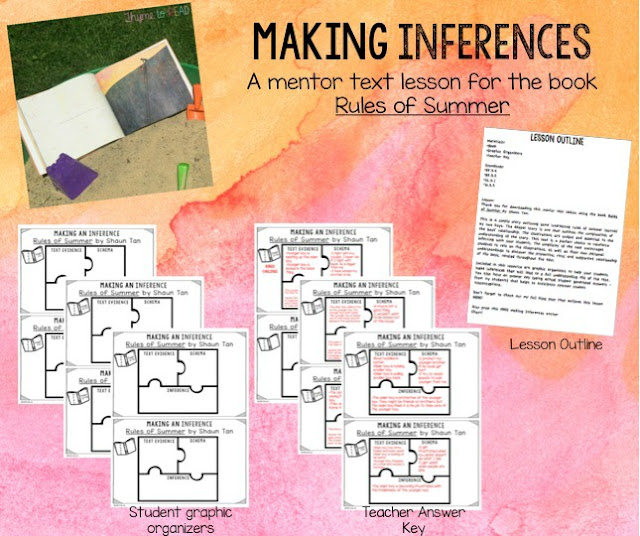
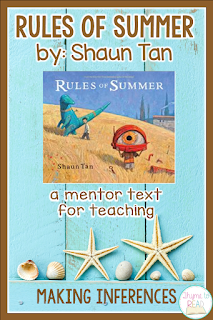
teaching with mentor text lessons for end of the year practice with making inferencesI have chosen to share a lesson that encourages peer collaboration and critical thinking, using the book Rules of Summer by Shaun Tan. This is a simple story outlining some interesting rules of summer learned by two boys. The deeper story is one that outlines the complexities of the boys' relationship. The illustrations are unique and essential to the understanding of the story. This text is a perfect choice to reinforce inferring with your students. The simplicity of the text encourages students to rely on the illustrations, as well as their own personal understandings to discover the protective, rival and supportive relationship of the boys, reveled throughout the text.
teaching with mentor text lessons for end of the year practice with making inferences 

teaching with mentor text lessons for end of the year practice with making inferencesThis lesson is probably best geared for students in 4-6 grade. You could use it for students in lower grades, however be sure they are capable of making successful inferences. The true meaning of the book is only accessed through the inferences they will make. Prior to reading Rules of Summer, you will want to instruct and model for your students how to make an inference. I have an anchor chart to help students visualize how to make an inference - grab this FREEBIE. Additionally, to scaffold this lesson, you may choose to directly tell your students that this text shows the ever changing relationship of the two characters. If you are using this text before the end of school, I would set the stage by explaining the rules in this books come from the freedom the characters have during the summer to use their imagination. However, if using this book as you ease back into the school year, you may chose to explain to your students that the relationships they have with their friends are always changing, developing, and even if rules are unspoken, the expectations guide their friendships. 

teaching with mentor text lessons for end of the year practice with making inferencesAs I was reading this book, I noticed four stages of the boys' relationship - PROTECTION, CONFLICT, RIVALRY, AND SUPPORT. If you are working with a smaller group or 1-on-1 setting you may only want to tackle one stage per day. If you are teaching your whole class, you could divide your class into four (or eight if you have a big class) teams. As you will see, the lesson groups similar pages of the text.
teaching with mentor text lessons for end of the year practice with making inferences
PROTECTION
These pages reveal one of the four stages. Using the text, illustrations and their prior knowledge of relationships, your students will be asked to form an inference about the boys and their feelings toward one another. They should use all of the pages in the section and cite text evidence (mostly from the illustrations) to support their inference. By having your class work in small groups, they will be able to collaborate on their
teaching with mentor text lessons for end of the year practice with making inferences
RIVALRY
responses and draw from each others' personal experiences to better develop their inferences.
Each group will focus on just one part of the text, so it will be crucial for your class to come together to share their inferences. After having a whole class discussion and facilitating any clarifications, I had my students write a summary paragraph of
teaching with mentor text lessons for end of the year practice with making inferences
SUPPORT
the boys' relationship. My students were asked to reference evidence from the text to support their claim about the always changing relationship of the two characters. Finally, in a concluding paragraph, I asked my students to make a connection to the story, and share a time in which they experienced a change in one of their friendships.
The collaboration of my students, the inferences they developed, and the connections they made were very impressive! To say I was proud of them would be an understatement.

teaching with mentor text lessons for end of the year practice with making inferencesThis book could lend itself to so many additional possibilities.  This website has a fabulous collection of ideas. I have highlighted a few of my favorites below. If you have any other ideas you would like to share, please leave a comment below!

1. Shaun Tan writes the rules in a NEVER vs ALWAYS format. Your student could generate a list of rule that they must follow over the summer or rules that govern their friendships. Encourage them to use an 'always' or 'never' format.
2. Explore the Power Struggle in this text. The two boys experience a struggle of power, and it effects their relationship. Ask your class which boy they sided with and why? Encourage them to reflect on how (maybe) their power role in their family played into their choice.
3. This one is my favorite! As I was reading this book for the first time, I kept having a bit of a nostalgic feeling. Then when I stumbled upon "The Classroom Bookshelf" and saw this activity, I knew exactly why. Rules of Summer reminded me of Where the Wild Things Are by Maurice Sendak. The boys in both texts have a mischievous side and the illustrations have the same dark feeling. Would your class enjoy comparing and contrasting the boys in this story to Max? I bet they would!

I truly hope you will try this lesson out with your students. My kiddos certainly enjoyed it! Here is a preview to all the goodies inside the full resource!
https://www.teacherspayteachers.com/Product/Making-Inferences-Lesson-2577293

If you have any questions about this resource, or how I used it in my classroom, please ask! I would love to collaborate with you.

PIN FOR LATER!
https://www.pinterest.com/pin/183873597265553774/

Check out these related posts: 

This post was part of a mentor text link up hosted by The Reading CrewOn each blog, a Summer mentor text lesson using a book and focusing on a vocabulary, comprehension or writing skill has been featured. The posts and resources from The Reading Crew, never disappoint, and this time was no different. Check out all the posts below
An InLinkz Link-up


Powered by Blogger.
Back to Top