Showing posts with label Writing. Show all posts

End of the Year Project for Revisiting Favorite Books


The end of the year is a great time for reflection. Our students have worked very hard to learn new skills and refine old ones. Great progress has been made, and it should be celebrated! 
Each year, my school hosts an academic fair, and in pretty typical fashion, students display work and projects they have completed throughout the year. This is my first year at the school, so it is also my first year participating. As a team of reading intervention teachers we don't do a lot of projects, but we see a lot of growth, so we made an exception and celebrated our students too! Keep reading to learn more about the project my students completed, and how you can implement in your classroom so your students can revisit favorite books from throughout the year. 


Keeping track of all the books my intervention students have read throughout the year is not a strength of mine! We have an intervention kit, with leveled readers, but I tend to stray don't follow the sequence at all. So I really relied on my students to remember what books were their favorite. It was really interesting to see what books my kiddos picked. Some of the younger girls shocked me by picking non-fiction. One of my boys who has made MONUMENTAL growth this year, without hesitation picked one of the first books we read in September. But the important part was that they picked the book, so they would be more invested.

We thought it would be really cute to make BOOK WORMS! Once my students had their books picked, we gathered materials to construct the reflection books. Good news, it's super easy!
  1. Various colors of construction paper
  2. Large circle tracers (8in diameter)-
  3. Writing paper template (grab it here)
  4. Scissors
  5. Glue
  6. Things for decorative touches (markers, eyes, extra construction paper)

Now that you have gathered all of your materials, it's time to get your students planning. When I did this project, I had my older students select what information from the book they wanted to highlight. For my littles, we worked together to set up each page, but there was some encouraging that pushed them in a certain direction. They used the rough draft paper, included in the writing paper template to plan out their ideas.

Each student included information like characters, setting, summary, favorite part and a book recommendation for fiction books.

For non-fiction they wrote about, three interesting facts, new vocabulary, something they were still wondering about, something about text structure (sequence, compare/contrast) and a book recommendation.

For my younger students, I provided them with sentence starters, but my older students got right to work. Most of them needed to refresh their memory, and took a minute to revisit the book. I did some conferencing with each student to help them recall facts and previous discussions we had while reading the book. Then the students worked with a peer to edit their rough drafts before moving on to their final copy. The final copy paper I used is also available in the paper template.

For organization purposes, I had the rough draft papers stapled in a packet, the final copy circles stapled in a separate packet, and when students came up to select construction paper for their background, I stapled those in a third packet.  All three packets were tucked nice and neatly into the book each student picked.  Then as they completed each step, the materials for the next step were readily available for them to move on.

Revisit favorite books from throughout the year with an end of the year book project Once the students had completed writing their final copy responses, they began to assemble their books. First students cut out the construction paper circles. You can use the 8 inch circle template provided for you. AND because you have stapled the colors together, it makes for easy one step cutting. Next, they cut out their final copy circles - again one step cutting because they are stapled together. Then the students needed to glue the final copy paper to the center of the construction paper. Finally, (this is the tricky part) the books need to be assembled into an accordion book. To do this, follow these steps:


  1. Take the first page and lay it text UP on the desk, put a dab of glue on the RIGHT side. 
  2. Take the second page and lay it text DOWN on top of the first page. So now you are looking at the back of the second page.
  3. Put a dab of glue on the LEFT side of the (2nd) circle, and lay the third page text UP on top of the second page. 
  4. Now you are "back to the beginning" with a text page facing up. So you will put a dab of glue on the Right and lay the next page text DOWN on top. 
  5. Continue this process until all pages have been assembled. 

When the book is closed, the front cover should be blank.  I had my students decorate the front cover with eyes, a mouth, antenna, the title and their name.


For the night of our academic fair, I placed each Book Worm with a copy of the book each student chose on the table. When the books worms are dry, they lay flat.  This was a great solution, so we could display MANY books on our tables at once, but not limit the students on how much they wanted to share. It also worked out perfectly because some of my students (even within the same grade level) really pushed themselves and completed a 5 piece book worm, while other students only completed three pieces. Displaying the books flat on the table did not "show off" the work the students did at first glance or provide a quick opportunity for comparison.


Almost every project showcased a DIFFERENT book we have read this year. It was great to have a wide variety. The students were proud of their work, and the parents were impressed with HOW MANY books they have read this year. The younger students loved checking out the older kids' book projects, to see what they might read in the coming years, and each Book Worm served as a recommendation for other students.


Overall, it was a great night and the students did a great job of showing off their progress. I hope this book project will help you in planning a way to celebrate how far your students have come. You could also keep these projects for your incoming class. This would be a great way to get them energized about the year to come, and as a way for this year's class to welcome your new students in September. 

If you have already planned an end of the year book project, you can always 
SAVE FOR LATER:

Check out these related posts:
Teaching Inferencing with a Mentor Text for Summer


Teaching Onomatopoeia: an exciting POP to writer's workshop


We made it! It is the end of the school year.  High-Fives to you! 
Now like I tell my students, just because testing is over, the weather is warmer, and the end is near, does not mean that we can stop working and learning. This is my favorite time to teach about descriptive language, especially Onomatopoeia. Descriptive Language is a fun skill that can help ease your class into summer vacation. 
I have a really fun book to share with you that can help introduce Onomatopoeia and model how to use it effectively to spice up your students' writing. 


Before reading, I like to share what onomatopoeia is with my students. To do so, I tell a (possibly very true) story about my morning. It goes something like this:  I woke up this morning and got out of bed. SQUEAK! I stepped on one of Reno's dog toys. Mr. Christensen groaned because he was not ready to wake up. SHH! I told him, go back to sleep. I went downstairs to put in a load of laundry and the washer WHOOSHED as I turned it on. Then, I came upstairs to start breakfast for Mr. C and Parker. Parker likes cereal and Mr. C like bacon, eggs and toast. As I turned on the toaster, it TIC, TIC, TIC'ed as I turned the knob, and the bacon SIZZLED in the pan. Behind me, I heard tiny footsteps...then BOO! it was Parker trying to scare me. I scooped him up and gave him a big kiss on the cheek MWAH! Parker helped me feed Reno, and CLICK, CLICK, CLICK went the dog food as Parker spilled it all over the floor. Then, Reno ran into the kitchen and ate it as fast as he could. CRUNCH! While this may not be the most natural story, it certainly helped introduce sound words with my students. It also allowed us to start having a discussion about how and why onomatopoeia can make our writing more interesting. 

Dear Fish by Chris Gall is one story you could use to introduce onomatopoeia to your students. It is a story about a boy, who wrote a message to the fish at the beach, inviting them to come visit someday. The next morning, strange things begin to happen and sea creatures start to visit his house, neighborhood and school. The author naturally uses onomatopoeia to illustrate how the sea animals are invading. The sawfish and hammerhead shark were seen "swooping and whooshing and a hammering and yammering," while the boy's dad was making a tree house. They only left a cloud of sawdust behind them. The illustrations are equally as amazing, as the engaging story and incredible examples of onomatopoeia. My students LOVED this book. The ending is quite a laugh!
 You can find more suggestions HERE, or the Froggy books by Jonathon London are another favorite of mine.

This book is jam packed with examples of onomatopoeia. The first time through, I usually like to just read the book, and let my students listen. I want them to enjoy the story, rather than focus too much on the task. This first day, we talk about the author's style, and how the use of onomatopoeia helps us paint pictures in our minds. The text is much more descriptive because of the use of these sounds words, and it helps draw us in as readers. My students can get there with some prompting, and by talking about their favorite parts with a partner.


The next day, I will re-read the text. While reading, I have asked students to record examples of sound words they hear. I have broken a class up into teams and asked them to record on certain pages. Each person gets a set of post-its and they write the sound words they hear. I know not every student is going to catch them all, so it is great to have them work together. After listening to the story, I have had my students, in their groups, brainstorm situations that would fit the examples they listed. This not only creates a list of words, but also gives students an idea on how to use them in their own writing.

After reading, either on the 2nd day, or even on a 3rd day, compile the list of words on a class anchor chart. Your groups can share out their words and how they might use them. Then together as a class, you could brainstorm more,  or review this FREE onomatopoeia word list.

With the list your class generates, or the provided word list, your students can now help to construct a classroom display that encourages everyone to use more onomatopoeia in their writing. This was my students' favorite part. Students can pick a word, or you can assign them a word, and they illustrate a poster describing the word. For example, for the word 'drip' a student of mine drew a leaky faucet with a drop of water coming out of it. These illustrations have always been so creative and helpful to other students trying to use more onomatopoeia in their writing.  These posters can help inspire a story, or help elaborate on an idea already in progress.


Now that our students understand what onomatopoeia is, what it is used for, and some examples, we need to get them to use it, so they can further develop their style. Here are THREE WAYS that will take your students from "teacher, teacher," to independent when using onomatopoeia.

Teacher Guided: When I have taught this skill, I have lead my groups through some examples of text without onomatopoeia. Together, with my help, my students worked to identify examples of onomatopoeia that could bring the sentences to life. I first modeled how I would think about my options; first considering the actions in the sentence, and thinking about a time that I may have witnessed a similar situation. I explain that in order for our writing to be believable, it is best if we can connect it to a real experience. The freebie above has some sentences you can discuss with your group. The included page is a fill in the blank page, with a word bank, so you could use it morning work, or a bell ringer after your small group lesson.

Collaborative: I think this is one of the most effective ways for our students to explore using onomatopoeia. Writing is a process, and this activity helps students realize that a writer's job is never done. I have my students pick a piece of writing they would like to improve, and with a partner they revisit their writing. They work together to re-read the writing, and make suggestions for opportunities to add onomatopoeia words.  

Independent: Finally, students can write a new piece. Again, writing is a process so it may not come naturally on the first draft. But hopefully they are keeping onomatopoeia in the back of their mind and creating opportunities for it to be added in later. If your students still need some coaching with this skills, you can add story inspiration pages to your writing center that will help to encourage them to write a story based around a specific onomatopoeic example.


I hope you enjoy teaching your students about onomatopoeia as much as I do, and found these suggestions helpful. And now as you ease into the last stretch of the year, you can cross at least one lesson plan off your to do list!

If you have already taught onomatopoeia this year, you can always 
SAVE FOR LATER:


Check out these related posts:
Read Aloud for R-Controlled Vowels
Summer Mentor Text for Inferencing
Spring Mentor Text for Descriptive Language
Spring Interactive Read Aloud


This post was part of a mentor text link up hosted by The Reading Crew. On each blog, a lesson using a book and focusing on a vocabulary, comprehension or writing skill has been featured. The posts and resources from The Reading Crew, never disappoint, and this time was no different. Check out all the posts below

Mentor Text Lesson to Warm Up Your Winter

Brrrr! Winter is in full swing here in the Northeast. I know I am doing everything I can to stay warm. If you are experiencing a little chill too, I hope me and my friends, from The Reading Crew, can bring you a little warmth and inspiration through our Winter Mentor Text link up. 
On each blog, we will be sharing a winter mentor text lesson, using a book we've chosen.  The lesson will model a vocabulary, comprehension or writing skill. The resources shared may be forever freebies, or may only be free for a limited time. Please take note of this as you visit each
blog.  So grab yourself a nice warm beverage, and settle in while you learn about resources you can bring back to your classroom in the new year.
This fall my family moved "back home." With moving, came a new house, new daycare for my son and a new job for my husband. For me, after being a reading specialist for the last four years, I'm not sure if I could handle one more big life change. So, I consider myself very lucky to have kept the same position in my new district and school.  I am now a proud POLAR BEAR (my new elementary school's mascot)! Well, when asked to pick a book for this link up, I knew just the one! The Polar Bear, written and illustrated by Jenni Desmond.

The Polar Bear is an informational picture book about the polar bear's habitat, body, diet, and life. The story is told through the eyes of a young girl who is reading a book about polar bears, and her character is placed in many of the illustrations. The factual text is paired with fantasy like illustrations that won this book the New York Times Best Illustrated Children's Book of 2016. Desmond does a wonderful job of presenting factually accurate information about polar bears in an easy to understand way. For example, Did you know the bumps on a polar bear's paw are similar to the bumps on a basketball? Desmond seems to be creating a "series" of nonfiction picture books, by writing about "vulnerable and threatened species." Her first book (for Enchanted Lion publishing) addressed blue whales, and her next book is set to uncover the life elephants.  

As I said before, I am now a proud Polar Bear! When I introduced this text to my students, I prefaced them with my wish to get to know our school mascot. I don't think it is enough to just know what our mascot is, we need to know why we are Polar Bears, what characteristics do we have in common, and what can we learn about the animal to make us stronger Polar Bears. Well that did it for my kiddos, they were all in.  Unless your school mascot is also the Polar Bear, you will need to think of a bigger "buy in." But, I must say that polar bears are really interesting creatures that deserve to be more understood. With the winter season upon us, there is no better time to study and explore the Arctic. You could use this book, and the resources available as a collaborative research project, that sets the stage for the students to begin their own Artic animal research projects. Before reading, you will want to provide the students with the note catcher (provided in this resource), so they can be actively listening and recording facts about polar bears. If working in small groups you may only want to tackle a few key topics at a time. Or, if you using this text with the whole class, you may wish to break the class up into groups so they only have to focus on a few topics, and later have the groups share out their responses. 


https://www.teacherspayteachers.com/Product/Paraphrasing-for-Polar-Bear-Research-2937754
 While reading this text aloud, stop to discuss vocabulary (evolved, repellent, solitary, etc.) and use the illustrations to construct more meaning for your students. Use some of this time to show your students how they can listen for key words in the text, and how those words can help them to predict when an answer might be coming. Also, use this time to show your students how you want them to use the provided notes catcher.  When using graphic organizers, I always take into account the ability of my students. My first graders are still working on writing a complete sentence, so to tell them they don't have to on a graphic organizer is very confusing, and sends mixed messages. My firsties always write in complete sentences. Although my second graders (and up), have a better grasp of being able to go back and forth based on the task. I allow them to just write key words and phrases. This also allows me to then help them answer questions in their own words and paraphrase the text. In the full resource, is a graphic organizer with suggested topics (and it is fully editable) to help guide your students while listening to the text.

An alternative to reading the whole text aloud to upper grade level students, would be to split the class up into groups and copy pages from the text. The students could read the section provided to them and pull out the relevant information needed to answer the questions. You could also provide them with supplemental texts on polar bears so their information comes from various sources.

https://www.teacherspayteachers.com/Product/Paraphrasing-Practice-FREEBIE-2937724
After your students have pulled key details from the text to address all of the topics, you will need to instruct them how to paraphrase. Paraphrasing can help your students bring in prior knowledge, show their deep understanding of content and also better remember what they have read. The sooner your kiddos can begin practicing paraphrasing, the better. My younger students (grades 1-3),  always paraphrase, however for my older students (grades 4-5), I teach them cite, then paraphrase. To teach paraphrasing, I have my students re-read the section they are trying to summarize, re-read their notes, close the book, turn over their paper and answer my question using the 4 R's of Paraphrasing.  In this forever FREEBIE, is an anchor chart and quotes from the text for your students to practice paraphrasing (editable options of both are included). Teaching students to paraphrase takes a lot of modeling (with think alouds), practice and time. When my students have had the most success, it is because they have been able to discuss their ideas with a partner, before committing them to paper. 

After your students have successfully answered the key questions, they can publish their polar bear research project. Included in the full resources is a student publishing book. The pages included address the same topics from the note catcher (and there is an editable page too!) My students of course enjoyed answering my final question of 'Why are you proud to be a Polar Bear?' They used the information they learned from the text, and we developed a list of qualities of a polar bear. They thought about how they have or could embody these qualities to be the very best Polar Bear they could be. As an extra bonus, I have included this question on a page of the published book.
Even if your school isn't the "Polar Bears," your classroom could adopt this amazing animal as a classroom mascot. Or, your class can use the included animal research template to provide information about various animals that could become your class mascot. Tie in some persuasive writing, a lesson on democracy, and you have yourself a class mascot election! 
 To Summarize: Paraphrasing is an important skill for your students to practice. By using the 4 R's of paraphrasing (Remain, Replace, Rearrange and Recheck), and explicit modeling/guided practice, your students will gain ownership of new content. The Polar Bear by Jenni Desmond, is a wonderful text to practice paraphrasing and then follow up with some simple animal research. Your students will not be able to resist sharing all they learned in this adorable All About Polar Bears book.


PIN THIS POST FOR LATER!
https://www.pinterest.com/pin/183873597267029994/

PIN THIS RESOURCE FOR LATER! 
https://www.pinterest.com/pin/183873597267029998/

Check out these related posts:
Fall Mentor Text for Theme
Spring Interactive Read Aloud
Spring Mentor Text for Descriptive Language

This post was part of a mentor text link up hosted by The Reading Crew. On each blog, a Winter mentor text lesson using a book and focusing on a vocabulary, comprehension or writing skill has been featured. The posts and resources from The Reading Crew, never disappoint, and this time was no different. Check out all the posts below


Teaching with Mentor Texts - Lessons for Use in the Summer

 teaching with mentor text lessons for end of the year practice with making inferences

Hello and WELCOME! Thank you for joining me, and The Reading Crew for our Summer Mentor Text link up. Whether you are still hanging in there, and counting down the days to summer break, teaching summer school/tutoring or if you're already planning for Back to School, we have a wealth of resources for you. On each blog, we will be sharing a Summer mentor text lesson, using a book we've chosen. The lesson will model a vocabulary, comprehension or writing skill.  The resources shared may be forever freebies, or may only be free for a limited time. Please take note of this as you visit the blogs.
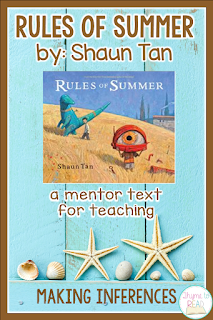
teaching with mentor text lessons for end of the year practice with making inferencesI have chosen to share a lesson that encourages peer collaboration and critical thinking, using the book Rules of Summer by Shaun Tan. This is a simple story outlining some interesting rules of summer learned by two boys. The deeper story is one that outlines the complexities of the boys' relationship. The illustrations are unique and essential to the understanding of the story. This text is a perfect choice to reinforce inferring with your students. The simplicity of the text encourages students to rely on the illustrations, as well as their own personal understandings to discover the protective, rival and supportive relationship of the boys, reveled throughout the text.
teaching with mentor text lessons for end of the year practice with making inferences 

teaching with mentor text lessons for end of the year practice with making inferencesThis lesson is probably best geared for students in 4-6 grade. You could use it for students in lower grades, however be sure they are capable of making successful inferences. The true meaning of the book is only accessed through the inferences they will make. Prior to reading Rules of Summer, you will want to instruct and model for your students how to make an inference. I have an anchor chart to help students visualize how to make an inference - grab this FREEBIE. Additionally, to scaffold this lesson, you may choose to directly tell your students that this text shows the ever changing relationship of the two characters. If you are using this text before the end of school, I would set the stage by explaining the rules in this books come from the freedom the characters have during the summer to use their imagination. However, if using this book as you ease back into the school year, you may chose to explain to your students that the relationships they have with their friends are always changing, developing, and even if rules are unspoken, the expectations guide their friendships. 
teaching with mentor text lessons for end of the year practice with making inferencesAs I was reading this book, I noticed four stages of the boys' relationship - PROTECTION, CONFLICT, RIVALRY, AND SUPPORT. If you are working with a smaller group or 1-on-1 setting you may only want to tackle one stage per day. If you are teaching your whole class, you could divide your class into four (or eight if you have a big class) teams. As you will see, the lesson groups similar pages of the text.
teaching with mentor text lessons for end of the year practice with making inferences
PROTECTION
These pages reveal one of the four stages. Using the text, illustrations and their prior knowledge of relationships, your students will be asked to form an inference about the boys and their feelings toward one another. They should use all of the pages in the section and cite text evidence (mostly from the illustrations) to support their inference. By having your class work in small groups, they will be able to collaborate on their
teaching with mentor text lessons for end of the year practice with making inferences
RIVALRY
responses and draw from each others' personal experiences to better develop their inferences.
Each group will focus on just one part of the text, so it will be crucial for your class to come together to share their inferences. After having a whole class discussion and facilitating any clarifications, I had my students write a summary paragraph of
teaching with mentor text lessons for end of the year practice with making inferences
SUPPORT
the boys' relationship. My students were asked to reference evidence from the text to support their claim about the always changing relationship of the two characters. Finally, in a concluding paragraph, I asked my students to make a connection to the story, and share a time in which they experienced a change in one of their friendships.
The collaboration of my students, the inferences they developed, and the connections they made were very impressive! To say I was proud of them would be an understatement.

teaching with mentor text lessons for end of the year practice with making inferencesThis book could lend itself to so many additional possibilities.  This website has a fabulous collection of ideas. I have highlighted a few of my favorites below. If you have any other ideas you would like to share, please leave a comment below!

1. Shaun Tan writes the rules in a NEVER vs ALWAYS format. Your student could generate a list of rule that they must follow over the summer or rules that govern their friendships. Encourage them to use an 'always' or 'never' format.
2. Explore the Power Struggle in this text. The two boys experience a struggle of power, and it effects their relationship. Ask your class which boy they sided with and why? Encourage them to reflect on how (maybe) their power role in their family played into their choice.
3. This one is my favorite! As I was reading this book for the first time, I kept having a bit of a nostalgic feeling. Then when I stumbled upon "The Classroom Bookshelf" and saw this activity, I knew exactly why. Rules of Summer reminded me of Where the Wild Things Are by Maurice Sendak. The boys in both texts have a mischievous side and the illustrations have the same dark feeling. Would your class enjoy comparing and contrasting the boys in this story to Max? I bet they would!

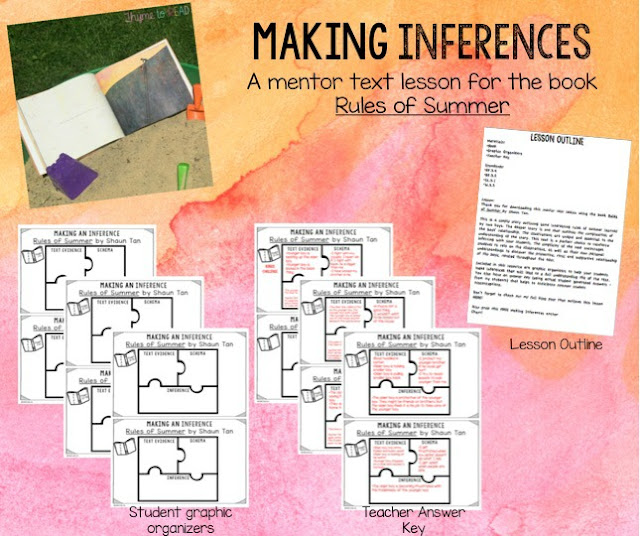
I truly hope you will try this lesson out with your students. My kiddos certainly enjoyed it! Here is a preview to all the goodies inside the full resource!
https://www.teacherspayteachers.com/Product/Making-Inferences-Lesson-2577293

If you have any questions about this resource, or how I used it in my classroom, please ask! I would love to collaborate with you.

PIN FOR LATER!
https://www.pinterest.com/pin/183873597265553774/

Check out these related posts: 

This post was part of a mentor text link up hosted by The Reading Crew. On each blog, a Summer mentor text lesson using a book and focusing on a vocabulary, comprehension or writing skill has been featured. The posts and resources from The Reading Crew, never disappoint, and this time was no different. Check out all the posts below
An InLinkz Link-up


Powered by Blogger.
Back to Top