Showing posts with label Comprehension. Show all posts

Help Readers Bloom with Make Way for Ducklings

Spring has sprung, and I am very excited to share a classic Spring story with you and your students. I had forgotten how much I loved this story, until it was gifted to my son, during a recent trip to Boston. 
When we checked into our hotel, the front desk couldn't help but notice my slightly overly excited three year old, who waited patiently bounced off every wall! When they delivered his "very special big boy bed" it came with a welcome bag. He received a water bottle, coloring book, special bedtime snack, and story. To say that it was thoughtful, would be an understatement! 
When tucking my son into bed that night, we read "Make Way for Ducklings" - the most perfect Springtime in Boston story! 
Not only is this a cute leisure bedtime read, but it is also a great read aloud to share with our students. There are many skills we can emphasize with an interactive read aloud. 

Book Summary

Make Way for Ducklings by Robert McCloskey (also the author of Blueberries for Sal) is a Caldecott Award winning story, about the journey of a family of ducks. Starting with Mr. and Mrs. Mallard looking for a place to nest, they fall in love with the Boston Public Gardens. But, after encountering some busy bikers, they eventually settle on the banks of the Charles River. After hatching their ducklings, and teaching them all the ducky ways, Mrs. Mallard does not give up on the Public Gardens. She enlists the help of Michael the policeman, to help her and the ducklings to their final family home. 

Teaching Vocabulary

Teaching vocabulary is so important, and often a skill that is overlooked. Introducing vocabulary can help set the stage to activate prior knowledge, while at the same time, begin to introduce new concepts to our students. Many times I have seen a student struggle to decode a word (that I really thought they should know), not because the phonics of the word was too difficult, but because their vocabulary just wasn't there yet. The vocabulary in this story is rich, not only as an introduction to a study on ducks, but also for words our students will encounter in other texts.
One activity I love to do when introducing new vocabulary, is to read off a list of words before starting the story, and have students predict what the words mean. This gives me a sense of their knowledge, and how much time to spend instructing on these words. I then assign each word to a select few students (the ones I know need a job to stay engaged) and it is their job to listen for their word throughout the story. When they hear their word, they quietly hold up a card to signal it's time to discuss the word. Then, using context clues, we try to uncover the meaning of the remaining words. I also DO NOT limit my students to ONLY the words I selected. Again, sometimes they surprise me with words they are unfamiliar with - and the whole point of going over vocabulary is to build background knowledge for the next time they encounter the word.


Before, During and After Reading

As I mentioned before, this book can make for a nice leisure read, as you transition out of the chaos of recess, however, this story can also be used to practice skills you have covered with your students throughout the year. By using before, during and after reading questions, you can engage your
students by discussing genre, making predictions and inferences and evaluating characters, setting, and important events. The depth our students are able to pull from the story, can truly depend on our scaffolded questioning.
Providing our students with the opportunity to ask questions is another important experience that can create during our interactive read alouds. I try to encourage all types of questions.  My students ask clarifying questions, if they need more of an explanation. But, they can also ask their peers comprehension check questions, which allows them to take on a teacher role. This allows my students to have great input in their learning, and increases their metacognition of the story - a skill (I hope) that will transfer into their independent reading.

Making connections by building knowledge

Normally, we talk about building background knowledge before reading with our students, however after reading is another

opportunity to build on our students' understanding. New knowledge is best developed by the connections students can make. This charming story can make a wonderful transition into a study about ducks, and other oviparous animals.
To further their learning, your students can continue reading about ducks with a paired non-fiction text.  The use of various graphic organizers will support them while continuing to build upon and organize new information. You can check their understanding using differentiated comprehension questions, before finally, students publish their own book "All About Ducks".

This FULL RESOURCE will save you time when planning your read aloud extension activities.


... And there's more

This story has potential to bridge connections with your math curriculum. Mr. and Mrs. Mallard have eight ducklings - that makes a family of 10. Your students could explore ways to make ten, and write word problems about the infamous Boston family. 

Additionally, Mr. and Mrs. Mallard name all of their children with final -ck word family endings. If applicable, a lesson or review of final -ck would be an appropriate phonics connection for this story. Check out some of these "student and teacher approved" final -ck activities!
   
If you have used this book with your students, I would love for you to share how you have made connections and built upon your students' knowledge - you can share in the comments below.

PIN FOR LATER:
Don't forget to check out the other incredible ideas, lessons and strategies shared by my teacher friends, linked below.  HAPPY SPRING!

Check out these other Mentor Text lesson ideas: 


This post was part of a mentor text link up hosted by The Reading Crew. On each blog, a lesson using a book and focusing on a vocabulary, comprehension or writing skill has been featured. The posts and resources from The Reading Crew, never disappoint, and this time was no different. Check out all the posts below

End of the Year Project for Revisiting Favorite Books


The end of the year is a great time for reflection. Our students have worked very hard to learn new skills and refine old ones. Great progress has been made, and it should be celebrated! 
Each year, my school hosts an academic fair, and in pretty typical fashion, students display work and projects they have completed throughout the year. This is my first year at the school, so it is also my first year participating. As a team of reading intervention teachers we don't do a lot of projects, but we see a lot of growth, so we made an exception and celebrated our students too! Keep reading to learn more about the project my students completed, and how you can implement in your classroom so your students can revisit favorite books from throughout the year. 


Keeping track of all the books my intervention students have read throughout the year is not a strength of mine! We have an intervention kit, with leveled readers, but I tend to stray don't follow the sequence at all. So I really relied on my students to remember what books were their favorite. It was really interesting to see what books my kiddos picked. Some of the younger girls shocked me by picking non-fiction. One of my boys who has made MONUMENTAL growth this year, without hesitation picked one of the first books we read in September. But the important part was that they picked the book, so they would be more invested.

We thought it would be really cute to make BOOK WORMS! Once my students had their books picked, we gathered materials to construct the reflection books. Good news, it's super easy!
  1. Various colors of construction paper
  2. Large circle tracers (8in diameter)-
  3. Writing paper template (grab it here)
  4. Scissors
  5. Glue
  6. Things for decorative touches (markers, eyes, extra construction paper)

Now that you have gathered all of your materials, it's time to get your students planning. When I did this project, I had my older students select what information from the book they wanted to highlight. For my littles, we worked together to set up each page, but there was some encouraging that pushed them in a certain direction. They used the rough draft paper, included in the writing paper template to plan out their ideas.

Each student included information like characters, setting, summary, favorite part and a book recommendation for fiction books.

For non-fiction they wrote about, three interesting facts, new vocabulary, something they were still wondering about, something about text structure (sequence, compare/contrast) and a book recommendation.

For my younger students, I provided them with sentence starters, but my older students got right to work. Most of them needed to refresh their memory, and took a minute to revisit the book. I did some conferencing with each student to help them recall facts and previous discussions we had while reading the book. Then the students worked with a peer to edit their rough drafts before moving on to their final copy. The final copy paper I used is also available in the paper template.

For organization purposes, I had the rough draft papers stapled in a packet, the final copy circles stapled in a separate packet, and when students came up to select construction paper for their background, I stapled those in a third packet.  All three packets were tucked nice and neatly into the book each student picked.  Then as they completed each step, the materials for the next step were readily available for them to move on.

Revisit favorite books from throughout the year with an end of the year book project Once the students had completed writing their final copy responses, they began to assemble their books. First students cut out the construction paper circles. You can use the 8 inch circle template provided for you. AND because you have stapled the colors together, it makes for easy one step cutting. Next, they cut out their final copy circles - again one step cutting because they are stapled together. Then the students needed to glue the final copy paper to the center of the construction paper. Finally, (this is the tricky part) the books need to be assembled into an accordion book. To do this, follow these steps:


  1. Take the first page and lay it text UP on the desk, put a dab of glue on the RIGHT side. 
  2. Take the second page and lay it text DOWN on top of the first page. So now you are looking at the back of the second page.
  3. Put a dab of glue on the LEFT side of the (2nd) circle, and lay the third page text UP on top of the second page. 
  4. Now you are "back to the beginning" with a text page facing up. So you will put a dab of glue on the Right and lay the next page text DOWN on top. 
  5. Continue this process until all pages have been assembled. 

When the book is closed, the front cover should be blank.  I had my students decorate the front cover with eyes, a mouth, antenna, the title and their name.


For the night of our academic fair, I placed each Book Worm with a copy of the book each student chose on the table. When the books worms are dry, they lay flat.  This was a great solution, so we could display MANY books on our tables at once, but not limit the students on how much they wanted to share. It also worked out perfectly because some of my students (even within the same grade level) really pushed themselves and completed a 5 piece book worm, while other students only completed three pieces. Displaying the books flat on the table did not "show off" the work the students did at first glance or provide a quick opportunity for comparison.


Almost every project showcased a DIFFERENT book we have read this year. It was great to have a wide variety. The students were proud of their work, and the parents were impressed with HOW MANY books they have read this year. The younger students loved checking out the older kids' book projects, to see what they might read in the coming years, and each Book Worm served as a recommendation for other students.


Overall, it was a great night and the students did a great job of showing off their progress. I hope this book project will help you in planning a way to celebrate how far your students have come. You could also keep these projects for your incoming class. This would be a great way to get them energized about the year to come, and as a way for this year's class to welcome your new students in September. 

If you have already planned an end of the year book project, you can always 
SAVE FOR LATER:

Check out these related posts:
Teaching Inferencing with a Mentor Text for Summer


Mentor Text Lesson to Warm Up Your Winter

Brrrr! Winter is in full swing here in the Northeast. I know I am doing everything I can to stay warm. If you are experiencing a little chill too, I hope me and my friends, from The Reading Crew, can bring you a little warmth and inspiration through our Winter Mentor Text link up. 
On each blog, we will be sharing a winter mentor text lesson, using a book we've chosen.  The lesson will model a vocabulary, comprehension or writing skill. The resources shared may be forever freebies, or may only be free for a limited time. Please take note of this as you visit each
blog.  So grab yourself a nice warm beverage, and settle in while you learn about resources you can bring back to your classroom in the new year.
This fall my family moved "back home." With moving, came a new house, new daycare for my son and a new job for my husband. For me, after being a reading specialist for the last four years, I'm not sure if I could handle one more big life change. So, I consider myself very lucky to have kept the same position in my new district and school.  I am now a proud POLAR BEAR (my new elementary school's mascot)! Well, when asked to pick a book for this link up, I knew just the one! The Polar Bear, written and illustrated by Jenni Desmond.

The Polar Bear is an informational picture book about the polar bear's habitat, body, diet, and life. The story is told through the eyes of a young girl who is reading a book about polar bears, and her character is placed in many of the illustrations. The factual text is paired with fantasy like illustrations that won this book the New York Times Best Illustrated Children's Book of 2016. Desmond does a wonderful job of presenting factually accurate information about polar bears in an easy to understand way. For example, Did you know the bumps on a polar bear's paw are similar to the bumps on a basketball? Desmond seems to be creating a "series" of nonfiction picture books, by writing about "vulnerable and threatened species." Her first book (for Enchanted Lion publishing) addressed blue whales, and her next book is set to uncover the life elephants.  

As I said before, I am now a proud Polar Bear! When I introduced this text to my students, I prefaced them with my wish to get to know our school mascot. I don't think it is enough to just know what our mascot is, we need to know why we are Polar Bears, what characteristics do we have in common, and what can we learn about the animal to make us stronger Polar Bears. Well that did it for my kiddos, they were all in.  Unless your school mascot is also the Polar Bear, you will need to think of a bigger "buy in." But, I must say that polar bears are really interesting creatures that deserve to be more understood. With the winter season upon us, there is no better time to study and explore the Arctic. You could use this book, and the resources available as a collaborative research project, that sets the stage for the students to begin their own Artic animal research projects. Before reading, you will want to provide the students with the note catcher (provided in this resource), so they can be actively listening and recording facts about polar bears. If working in small groups you may only want to tackle a few key topics at a time. Or, if you using this text with the whole class, you may wish to break the class up into groups so they only have to focus on a few topics, and later have the groups share out their responses. 


https://www.teacherspayteachers.com/Product/Paraphrasing-for-Polar-Bear-Research-2937754
 While reading this text aloud, stop to discuss vocabulary (evolved, repellent, solitary, etc.) and use the illustrations to construct more meaning for your students. Use some of this time to show your students how they can listen for key words in the text, and how those words can help them to predict when an answer might be coming. Also, use this time to show your students how you want them to use the provided notes catcher.  When using graphic organizers, I always take into account the ability of my students. My first graders are still working on writing a complete sentence, so to tell them they don't have to on a graphic organizer is very confusing, and sends mixed messages. My firsties always write in complete sentences. Although my second graders (and up), have a better grasp of being able to go back and forth based on the task. I allow them to just write key words and phrases. This also allows me to then help them answer questions in their own words and paraphrase the text. In the full resource, is a graphic organizer with suggested topics (and it is fully editable) to help guide your students while listening to the text.

An alternative to reading the whole text aloud to upper grade level students, would be to split the class up into groups and copy pages from the text. The students could read the section provided to them and pull out the relevant information needed to answer the questions. You could also provide them with supplemental texts on polar bears so their information comes from various sources.

https://www.teacherspayteachers.com/Product/Paraphrasing-Practice-FREEBIE-2937724
After your students have pulled key details from the text to address all of the topics, you will need to instruct them how to paraphrase. Paraphrasing can help your students bring in prior knowledge, show their deep understanding of content and also better remember what they have read. The sooner your kiddos can begin practicing paraphrasing, the better. My younger students (grades 1-3),  always paraphrase, however for my older students (grades 4-5), I teach them cite, then paraphrase. To teach paraphrasing, I have my students re-read the section they are trying to summarize, re-read their notes, close the book, turn over their paper and answer my question using the 4 R's of Paraphrasing.  In this forever FREEBIE, is an anchor chart and quotes from the text for your students to practice paraphrasing (editable options of both are included). Teaching students to paraphrase takes a lot of modeling (with think alouds), practice and time. When my students have had the most success, it is because they have been able to discuss their ideas with a partner, before committing them to paper. 

After your students have successfully answered the key questions, they can publish their polar bear research project. Included in the full resources is a student publishing book. The pages included address the same topics from the note catcher (and there is an editable page too!) My students of course enjoyed answering my final question of 'Why are you proud to be a Polar Bear?' They used the information they learned from the text, and we developed a list of qualities of a polar bear. They thought about how they have or could embody these qualities to be the very best Polar Bear they could be. As an extra bonus, I have included this question on a page of the published book.
Even if your school isn't the "Polar Bears," your classroom could adopt this amazing animal as a classroom mascot. Or, your class can use the included animal research template to provide information about various animals that could become your class mascot. Tie in some persuasive writing, a lesson on democracy, and you have yourself a class mascot election! 
 To Summarize: Paraphrasing is an important skill for your students to practice. By using the 4 R's of paraphrasing (Remain, Replace, Rearrange and Recheck), and explicit modeling/guided practice, your students will gain ownership of new content. The Polar Bear by Jenni Desmond, is a wonderful text to practice paraphrasing and then follow up with some simple animal research. Your students will not be able to resist sharing all they learned in this adorable All About Polar Bears book.


PIN THIS POST FOR LATER!
https://www.pinterest.com/pin/183873597267029994/

PIN THIS RESOURCE FOR LATER! 
https://www.pinterest.com/pin/183873597267029998/

Check out these related posts:
Fall Mentor Text for Theme
Spring Interactive Read Aloud
Spring Mentor Text for Descriptive Language

This post was part of a mentor text link up hosted by The Reading Crew. On each blog, a Winter mentor text lesson using a book and focusing on a vocabulary, comprehension or writing skill has been featured. The posts and resources from The Reading Crew, never disappoint, and this time was no different. Check out all the posts below


Reading and Writing Strategies: A Mentor Text Lesson for Fall

This post contains affiliate links
Happy Fall my friends! I hope the first weeks of school have treated you well and this year is shaping up to be the best year ever. I love using mentor text lessons to kick off a new comprehension or writing skill. Using a beloved picture book to model for your students the process you take to fully understand a text is so important. It is a great time to slow down, and practice the "I do" and "We do" of a gradual release model before letting students practice the "You do" on their own. 
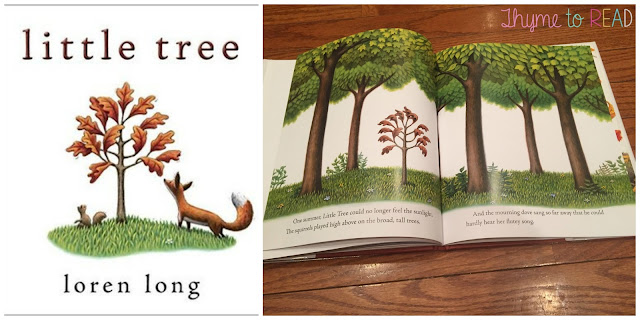
A favorite Fall book of mine is, Little Tree by Loren Long. Long is the illustrator of The Little Engine that Could, author of the favorite, Otis the Tractor books, and he co-authored Of Thee I Sing with President Obama. These titles are well worth the trip to your local bookstore to check out.
Little Tree by Loren Long mentor text lesson to support understanding theme
Little Tree is about a tree who loves life, and cherishes its' leaves, so it holds onto the leaves throughout several seasons, and as a result remains unchanged. Everything grows and changes around the tree, but it continues to hold onto the leaves. After much time, the tree comes to realize the decision it must make, and embraces change and growth. The tree drops its' leaves and grows into a large, strong tree.
 
On the surface, this text would be a great addition to your library, to welcome Fall and discuss the changes of the season.  This text, paired with a non-fiction text about the changes of Fall would kick off the season perfectly. However, there is a deeper meaning about personal change and growth. The tree needed to let go of something very important to it, so it could grow into something even more amazing.

https://www.teacherspayteachers.com/Product/Theme-Anchor-Charts-and-Posters-2819007
Before reading this text, you will want to introduce your students to THEME.  When starting a new skill, I always seem to be asked, why do we need to learn this, or how will this "really" help me? So, for that reason, I have started giving my students the 'why' right up front. Not only do I instruct on what the theme is, but I also tell my students why we need to uncover the theme. This can help establish the importance of your lesson, and hopefully cut back on the "why whines" as I call them.


https://www.pinterest.com/pin/183873597266500019/
To start, you can discuss with your students themes of other popular texts, movies or songs. It is important to share with them some key components of a text they will need to understand in order to determine the theme successfully.  Skills such as summarizing, and identifying character traits should be introduced prior to teaching about theme. This anchor chart FREEBIE can help you set the stage to explain and justify your lesson on theme. 

To introduce the text, you can ask students what they know about trees in the fall. Hopefully you will get a lot of discussion about how they change, and eventually drop their leaves.  Then, you can ask students to predict what would happen if a tree didn't drop its' leaves.  You may choose to prepare your students even more and ask them about a time they were afraid or resisted change. You can ask them about the outcome of resistance - Did change come anyway? What positives came about because of change? Who helped them through a change?

While reading, you can draw your students' attention to the changes (or lack of) the little tree is experiencing. When discussing within the text, you can ask your students to compare and contrast the little tree to the trees around it (they can use the illustrations). Starting to discuss beyond the text, your class could share why the tree is not letting go of its' leaves - the leaves provide shade, and rustle in the breeze - the tree loves its' leaves. You can challenge your students to really think beyond the text, and make an inference that the tree is comfortable holding onto its' leaves, and is avoiding change.

Once you have read the text aloud to your class, and guided them through discussion that will help their understanding of the story and character, it is time to start uncovering the theme. 
If you are using this text to introduce theme for the first time, or as a reteaching, the remaining part of the lesson would best be done as a teacher heavy think aloud, with leading questions that will help your students construct the theme.  If your students are familiar with theme, and this text is serving additional practice, you can provide scaffolding through your questions, but release more of the discussion and uncovering to your students.

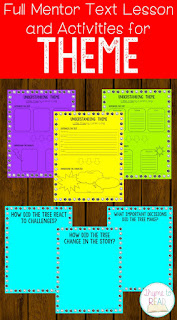
https://www.teacherspayteachers.com/Product/Understanding-Theme-Mentor-Text-Lesson-2819000
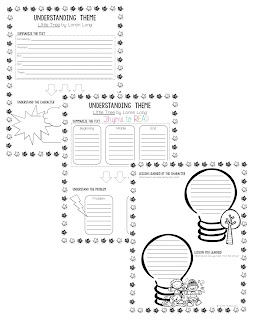
You can now use your during reading discussion to summarize the story, paying special attention to the problem and solution of the story.  I find using the Somebody, Wanted, But, So, Then structure very helpful for students to easily identify and relate the problem and solution within the story. However, in the resource that supports this text, I included a differentiated option for your students. You can use Beginning, Middle and End to summarize the story, and also highlight the problem and solution (either in writing or pictures).  This version may better support your struggling readers.

Understanding the character is very important to the development of theme, so you could draw upon your discussion of why the tree held onto its' leaves. With my students, I identified the tree as 'reluctant'. We then pulled evidence of the tree's actions, thoughts and dialogue to support this trait. By describing the tree as reluctant, nervous or uncertain, it connects the problem and starts to shed light on the fear that comes with change and the unknown. Some of my students picked up on the tree's personal growth, and argued that the tree was brave. This discussion and evidence of character change, made for the perfect transition into a discussion of theme. 

https://www.pinterest.com/pin/183873597266513408/
I don't know about your students, but mine LOVE to talk. They are getting better at academic talk, but they just have a need to converse! With that said, I try to give them as many opportunities to do so throughout the school day.  This lesson was no exception.  By breaking my class up into small groups, I was able to facilitate more discussions than I could with a whole group.  I proposed three questions related to the tree overcoming the internal struggle. In the small groups, students discussed their answers to these questions. As a group, they developed a collaborative answer and wrote it on a post-it. The post-it was left behind on a poster (with the question), and they moved to the next question.  In about 15 minutes, all students had collaboratively answered all three questions and were ready to debrief. 

To get my students thinking about the text, I asked why they felt the author wrote this text. Yes, I got in a quick author's purpose question there. But, it is because author's purpose IS the theme. I really try to teach these skill together. In this case, the author wanted to model a lesson about growth and change through the experiences of a little tree. I also find my students have a hard time understanding that theme isn't just the lesson that the character learned.  So often I hear the lesson learned is that 'the tree needed to drop its' leaves so it could grow into a big, tall tree.' Yes, that is the lesson the tree learned, but, that is not the theme. For my students, it has been crucial to connect the lesson learned to themselves, so they can best uncover the theme. By now taking the tree out of the lesson, they can be left with how everyone must go through change, sometimes difficult and unwanted change, to learn and grow up. 

Finally, to wrap up this lesson, you could connect this to a writing prompt in which students write about a time they needed to change, and have them describe the outcome of that change. The stories are always very interesting, and can be revealing of some deep stories from the students who need our love the most - which makes this a perfect theme not only for the changing of seasons, but also still so early in the year when we are getting to know our students. 
https://www.pinterest.com/pin/183873597266479683/

This is such a wonderful book to share in early or late fall as the tree are really starting to loose their leaves. Change and growth from change are themes all of our students experience, and this text does a great job of sharing and explaining that message in an easy to understand way. 

Checkout these related posts:

This post was part of a mentor text link up hosted by The Reading Crew. On each blog, a Fall mentor text lesson using a book and focusing on a vocabulary, comprehension or writing skill has been featured. The posts and resources from The Reading Crew, never disappoint, and this time was no different. Check out all the posts below. 


Powered by Blogger.
Back to Top